

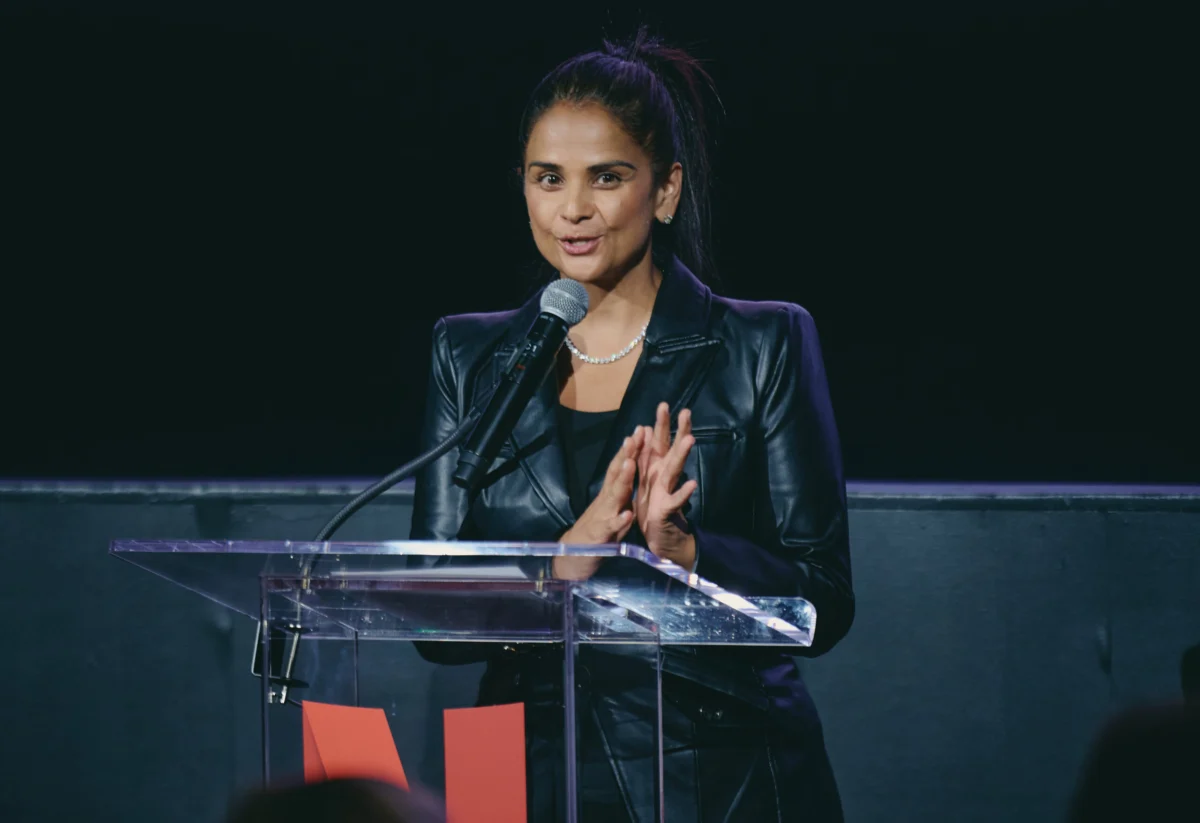
Netflix, the global streaming titan, is meticulously crafting its live sports strategy, focusing on a curated selection of "events" rather than pursuing extensive, costly packages of games. This discerning approach, articulated by Chief Content Officer Bela Bajaria in a recent exclusive interview with CNBC Sport, underscores the company’s commitment to delivering high-impact, culturally resonant moments that transcend traditional viewership to become unmissable, conversational phenomena. Bajaria’s insights from Melbourne, Australia, following the platform’s broadcast of the first-ever regular-season NFL game in the country, illuminate a calculated pivot in the streaming wars, emphasizing strategic content acquisition and innovative partnership models.
The Philosophy of the "Unmissable Event"
At the core of Netflix’s live content strategy lies a precise definition of what constitutes an "event." Bajaria describes it as something "buzzy, cultural, zeitgeist – that really sort of unmissable moment." This isn’t merely about broadcasting a game; it’s about transforming a sporting contest or a performance into appointment television that generates significant public discourse. For Netflix, an event must possess an inherent quality that encourages communal viewing and post-broadcast discussion, aligning with its brand identity built on engaging narratives and shared cultural experiences. This philosophy stands in stark contrast to the volume-driven content strategies often adopted by traditional sports broadcasters and emerging streaming competitors, who aim to secure vast catalogs of games and leagues.
The company’s selective acquisition strategy is designed to maximize impact and engagement without incurring the exorbitant costs associated with broad sports rights packages. While competitors like Amazon, Apple, and even Disney’s ESPN have invested billions in securing long-term rights to major leagues, Netflix appears to be carving out a niche focused on exclusivity, novelty, and cultural resonance. This approach allows Netflix to experiment with diverse forms of live content, ranging from high-stakes athletic feats to global music concerts, all unified by their potential to capture the collective imagination.
The NFL Experiment: Global Reach Meets Curated Moments
The recent NFL game in Melbourne, which saw the San Francisco 49ers defeat the Los Angeles Rams 27-7, served as a prime example of Netflix’s event-centric strategy in action. Netflix held the global rights to this historic fixture, marking the NFL’s debut regular-season game in Australia. This move aligns with the NFL’s ambitious international expansion efforts, which have seen games hosted in London, Germany, and Brazil in recent years, demonstrating a concerted push to grow the league’s global footprint. For Netflix, broadcasting this game was not just about American football; it was about leveraging its massive international subscriber base to deliver a significant, one-off cultural moment.
Bajaria’s comments underscore the selective nature of Netflix’s NFL involvement. When queried about the potential acquisition of a package akin to NBC’s "Sunday Night Football," the most popular primetime program for an unprecedented 15 consecutive years, Bajaria light-heartedly remarked that such an investment would deplete the company’s substantial $20 billion content budget. This humorous retort highlights the fundamental difference between Netflix’s event-driven strategy and the traditional broadcast model of securing comprehensive league packages.
Instead, Netflix’s 2026-27 NFL season commitment comprises five strategically chosen games: the inaugural Australia game, the first-ever Thanksgiving Eve game, two Christmas Day matchups, and a pivotal Week 18 game guaranteed to have significant playoff implications. Each of these selections is imbued with an inherent "event" quality. Christmas Day games, for instance, naturally lend themselves to Bajaria’s vision of a holiday spectacle, potentially featuring high-profile halftime entertainment similar to Beyoncé’s proposed involvement in a past Christmas Day game on Netflix. The Thanksgiving Eve and Week 18 games similarly offer unique scheduling or high-stakes narratives that elevate them beyond a standard regular-season fixture.
This strategy echoes earlier statements from Netflix co-CEO Ted Sarandos, who has consistently reiterated that the company is not interested in acquiring broad sports packages. The NFL, recognizing the evolving media landscape, is reportedly open to reworking its established game packages, particularly as it approaches an opt-out clause in its current media rights deal after the 2029-30 season. NFL Commissioner Roger Goodell’s acknowledgment of this flexibility could open avenues for Netflix to acquire specialized packages, such as international games, which Bajaria confirmed would be appealing given Netflix’s vast global audience and the NFL’s international growth ambitions. With nine international games scheduled for the current year and ten for the next season, a dedicated international package could perfectly align with Netflix’s global focus and "event" criteria.
Global Sporting Spectacles: FIFA World Cup Ambitions
Beyond American football, Netflix is actively exploring opportunities in global football, specifically expressing interest in bidding for the FIFA Men’s World Cup rights for 2030 and 2034. This interest follows the company’s successful acquisition of the U.S. and Canadian rights for the FIFA Women’s World Cup in 2027 and 2031, reportedly for a sum of $200 million. The Women’s World Cup, a rapidly growing global phenomenon, perfectly embodies the "cultural, zeitgeist" qualities Netflix seeks in its live events.
Bajaria emphasized Netflix’s "great partnership and relationship with FIFA," suggesting that ongoing conversations for future rights are a natural progression. The Men’s World Cup, as the most-watched sporting event globally, represents the pinnacle of "appointment TV" on a truly massive scale. Its quadrennial occurrence, combined with its profound cultural significance in virtually every corner of the world, makes it an ideal candidate for Netflix’s event-driven strategy. Acquiring even a portion of these rights, especially for key international markets, would provide Netflix with unparalleled content to engage its diverse global subscriber base, further cementing its position as a destination for major cultural moments.

Innovative Distribution: The Rise of Content Ingestion and Partnerships
The landscape of content distribution is undergoing a profound transformation, with media companies increasingly exploring novel strategies for streaming. Bajaria indicated Netflix’s openness to a new model of "ingesting" content from other media companies, a concept recently pioneered by YouTube with its integration of NBCUniversal’s Peacock content into its Premium subscription platform. This model represents a departure from traditional licensing agreements, suggesting a future where platforms might act as super-aggregators, embedding live or premium content from various providers directly within their services.
Netflix has already embarked on a "test" of this concept through a partnership with France’s TF1 Group, embedding live content from the local media company onto its service. This experimental collaboration allows Netflix to gauge the viability and user experience of such integrations. Bajaria highlighted the existing, multifaceted relationships Netflix already maintains with companies like NBCUniversal, which licenses feature films to Netflix and whose NBC Sports division produces live events for the streamer, including the recent Australia NFL game. These pre-existing partnerships could serve as a foundation for more expansive content ingestion agreements, fostering a comfort level that enables both parties to explore innovative distribution models.
The implications of content ingestion are significant. For Netflix, it could offer a pathway to enrich its live content offerings without directly acquiring all rights, potentially reducing financial risk while expanding variety. For partner companies, it provides access to Netflix’s vast global subscriber base, potentially driving viewership and new subscriptions to their standalone services. This model could reshape how exclusive content is distributed, challenging traditional notions of platform exclusivity and paving the way for more integrated, user-centric streaming experiences. The industry’s move towards bundles and strategic alliances, exemplified by the recent Disney+/Hulu/ESPN+ bundle or Max’s Bleacher Report add-on, suggests a future where collaboration, not just competition, defines the streaming ecosystem.
Maintaining Focus: The Bedrock of Long-Form Storytelling
Despite these explorations into live events and content ingestion, Bajaria firmly reiterated Netflix’s core commitment to its foundational business: premium long-form TV series and movies. She dismissed the notion of Netflix pivoting to compete directly with short-form video services like YouTube, even as Nielsen data consistently shows YouTube’s growing dominance in streaming market share, accounting for 14.2% of all streaming viewership in July, compared to Netflix’s 7.8%.
Bajaria’s stance is rooted in a belief that quality long-form storytelling remains universally appealing, regardless of demographic. "It’s too hand-wavy or dismissive to say, ‘Oh, young people only watch short things,’" she asserted. "When we make things for young people that they feel are really authentic and great, they will come. And that’s the business. We’re still in that. We support creators and filmmakers and visions. We invest in film and TV. Really great stories connect with people all day long."
This steadfast commitment to high-quality, produced entertainment distinguishes Netflix from platforms primarily driven by user-generated content or ephemeral viral videos. While TikTok and YouTube thrive on brevity and immediacy, Netflix’s strategy focuses on immersive narratives that command sustained attention. The company’s continued investment in diverse creators and ambitious projects, from critically acclaimed dramas to blockbuster films, underscores its confidence in the enduring power of compelling storytelling. This dual approach – a highly selective, event-driven live content strategy complementing its robust library of series and films – positions Netflix to navigate the evolving streaming landscape by leveraging its strengths while adapting to new opportunities.
Broader Impact and Future Outlook
Netflix’s strategic evolution comes at a critical juncture for the streaming industry. The initial gold rush of subscriber growth has matured, leading to intense competition, rising content costs, and a renewed focus on profitability. By carefully curating live events, Netflix aims to generate buzz and attract new subscribers without entering a costly bidding war for comprehensive sports packages that may not align with its global, on-demand consumption model. This approach also allows for flexibility, enabling Netflix to test various sports and entertainment genres to determine what resonates most with its diverse audience.
The openness to content ingestion further demonstrates Netflix’s adaptability. In an era of streaming fatigue, where consumers face an overwhelming number of subscriptions, platforms that can consolidate content or offer compelling bundles may gain a significant advantage. By potentially integrating content from partners, Netflix could enhance its value proposition, offering a broader array of live and premium content without sacrificing its core identity or incurring full acquisition costs.
Ultimately, Netflix’s strategy under Bela Bajaria is one of calculated innovation. It is about identifying and acquiring culturally significant "moments" in the live content space, while simultaneously exploring groundbreaking partnership models to enrich its offerings. Crucially, it is about doing all of this while remaining steadfastly committed to the high-quality, long-form series and films that built its empire. This nuanced, multi-pronged approach positions Netflix not just to compete, but to redefine what a global streaming service can be in an increasingly dynamic and fragmented media world.
