

Across the United States, a contentious debate is unfolding as communities grapple with the prospect of new artificial intelligence (AI) data centers being built in their backyards. While data center companies and their industry customers champion promises of new jobs and significant economic growth, this narrative has largely failed to sway public opinion. A recent Gallup poll reveals that a majority of Americans actively oppose data center construction in their immediate vicinity, driven primarily by profound environmental and energy concerns, alongside worries about local resource strain and quality of life. This resistance underscores a deeper societal tension between technological advancement and sustainable community development, highlighting the complex trade-offs involved in the rapidly expanding digital infrastructure.
Philadelphia’s Legacy of Industrialization: A Microcosm of Conflict
For Shawmar Pitts, a tireless activist and lifelong resident of the Grays Ferry neighborhood in Southwest Philadelphia, these environmental and energy concerns are far from theoretical. Pitts’ life story is deeply interwoven with the long shadow cast by American industrialization. He grew up adjacent to what was once the East Coast’s largest oil refinery, a colossal industrial complex that processed up to 335,000 barrels of crude oil daily before a catastrophic explosion in 2019 forced its permanent closure. For decades, the refinery was a dominant feature of the landscape, providing jobs but also emitting pollutants that residents believe contributed to widespread health issues.
Pitts recounts how chronic health conditions plagued many of his friends and family, a reality he once accepted as an unfortunate fact of life in an industrial zone. The true gravity of the situation, however, didn’t fully register until 2018. That year, he encountered members of Philly Thrive, a grassroots environmental justice group, who were tabling in his neighborhood to raise awareness about a proposed oil refinery expansion. "I read the information they had on the table about how living near the refinery affects you, and I’m looking at all the sicknesses on this paper, and I’m like, ‘My mother has this, my sister has that, my next-door neighbor suffers from this’ — every house, someone has something on that list,” Pitts told TechCrunch. This stark realization ignited his passion for environmental advocacy. "From that point, I was all the way in," he affirmed, marking a pivotal moment in his commitment to community health and environmental justice.
Today, Shawmar Pitts serves as the managing co-director of Philly Thrive, channeling his personal experience into a broader fight for his community. He is now at the forefront of a burgeoning movement advocating for a data center moratorium in Philadelphia. Although no formal construction proposals have yet been approved, city officials have identified two potential sites for future data center development: one in Northeast Philadelphia and another, significantly, within Pitts’ own Grays Ferry neighborhood. The irony is not lost on residents, who see the potential for a new form of industrial burden replacing an old one, threatening to perpetuate a cycle of environmental injustice.
The Human Cost: Testimonies from the Front Lines

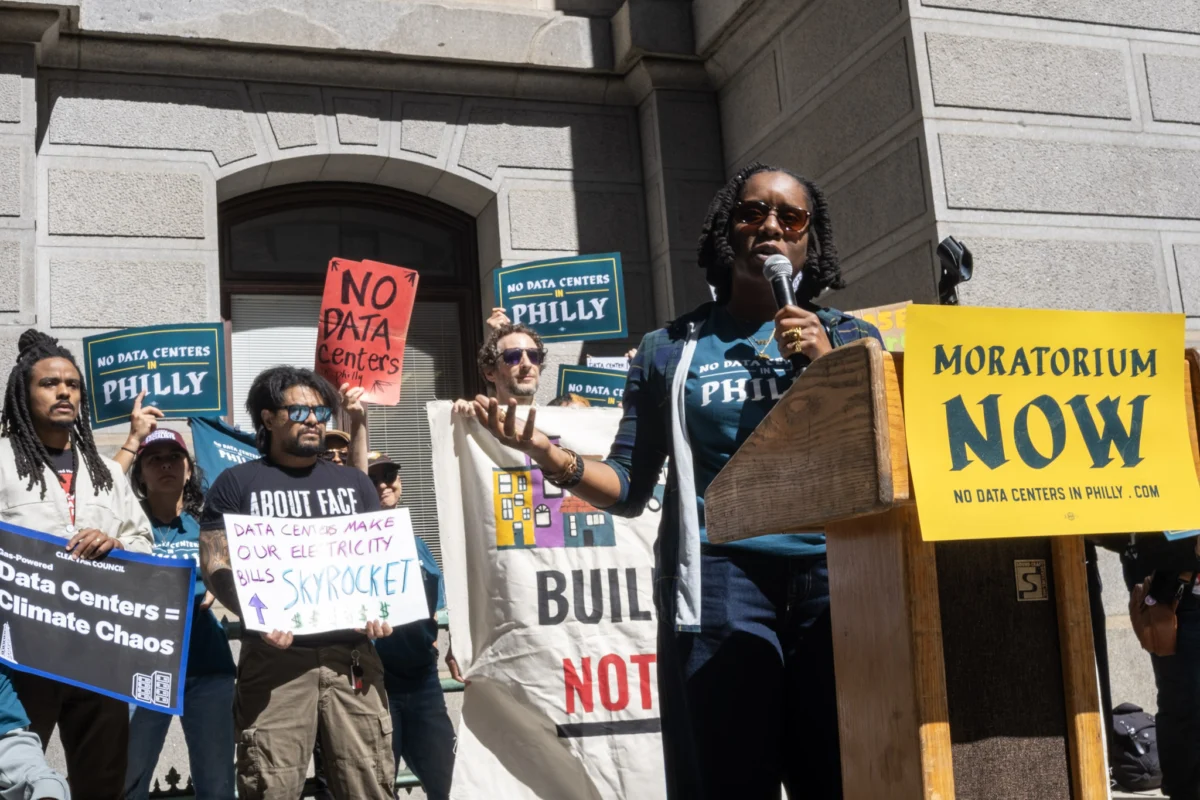
The recent "No Data Centers in Philly" rally held at Philadelphia’s City Hall underscored the deeply personal impact of industrial pollution on residents. Sonya Sanders, the board president of Philly Thrive, delivered an impassioned plea, stating unequivocally, “We don’t want data centers. We don’t want the pollution, we don’t want the noise, and we know they’re not going to bring us more jobs.” Her words resonated with the lived experiences of many in the crowd.
Sanders’ own story is a tragic testament to the perceived consequences of industrial proximity. Her husband, also a resident of Grays Ferry, passed away in 2020 from a rare bone cancer. She firmly believes that emissions from the former oil refinery directly caused his illness, emphasizing that he was a non-smoker and non-drinker. “In my eyes, they killed him,” she declared at the rally, her voice heavy with grief and conviction. “The pollution killed him. I believe he would be here today if he wasn’t silently murdered, because it was the pursuit of profit that killed him.” Such powerful testimonies illustrate the profound distrust and anger that communities like Grays Ferry harbor towards industrial projects, regardless of their modern guise. They highlight a historical pattern where economic development has often come at the expense of public health and environmental integrity in marginalized communities.
The Alarming Environmental Footprint of the AI Race
While a potential Philadelphia data center might not match the sheer scale of environmental impact of the defunct Philadelphia Energy Solutions refinery, the global race to dominate the AI industry is creating an unprecedented demand for energy and resources, leading to significant environmental consequences. The computational intensity required for training and operating large AI models necessitates massive data centers, which are essentially colossal warehouses filled with powerful, heat-generating servers. These facilities consume staggering amounts of electricity, primarily for running the servers themselves and, crucially, for the extensive cooling systems required to prevent overheating.
BloombergNEF, a leading provider of strategic research on energy, has issued a stark warning: by 2035, U.S. data centers could consume more natural gas than Germany and Japan combined. This projection represents almost double the firm’s estimate from just nine months prior, underscoring the accelerating pace of AI development and its escalating energy demands. This surge in consumption is largely driven by the reliance on fossil fuels for electricity generation in many regions.
Despite natural gas burning cleaner than other fossil fuels like coal or oil, it is far from a harmless energy source. The combustion of just one cubic foot of natural gas releases the equivalent of approximately 60 grams of carbon dioxide (CO2). The projected additional data center demand is expected to generate an extra 1 million metric tons of greenhouse gas pollution each day. To put this into perspective, this daily increase alone accounts for roughly 12% of all current U.S. greenhouse gas emissions, a substantial contribution that directly exacerbates climate change.
Beyond CO2, the environmental toll extends to air quality. Harvard University researchers found in 2021 that fossil fuel air pollution is responsible for a staggering one in five deaths worldwide. This figure is bound to increase as the energy demands of the AI era continue to grow, posing a severe threat to global public health.

Moreover, data centers are notorious for their substantial water consumption, primarily used for cooling their vast arrays of servers. While the original article did not extensively detail water usage, it is a critical environmental concern. Cooling systems in many modern data centers evaporate millions of gallons of water annually, straining local water supplies, particularly in regions already facing drought or water scarcity. This hidden cost adds another layer of environmental burden to communities hosting these facilities.
Noise pollution is another overlooked issue. The constant hum of thousands of servers, coupled with the roar of cooling units and backup diesel generators, can create a persistent and disruptive noise profile for surrounding residential areas, further diminishing quality of life for nearby residents.
The Role of Diesel Generators: A Looming Threat
Adding to the complexity are the hundreds of diesel engines typically found at data center sites. These generators are theoretically reserved for emergencies, intended to kick in during power outages to ensure continuous operation. However, environmental advocates highlight a troubling reality. "A typical data center planned in Pennsylvania has hundreds of diesel engines that spew air pollution, and even if they’re supposedly reserved for emergencies, the government has already said that the data center should use those rather than drawing from an overstressed electrical grid during some heat waves,” stated Annie Fox, an attorney with the Clean Air Council, at the Philadelphia rally.
Fox’s statement points to a critical policy dilemma: as electrical grids become increasingly strained during peak demand periods, such as summer heatwaves, authorities might permit or even encourage data centers to rely on their diesel generators to reduce stress on the main grid. This scenario, she warns, will become more frequent as climate change intensifies heatwaves. “We can expect that to get more frequent… Fossil fuel-hungry data centers will worsen climate change, making those heatwaves more frequent and severe,” Fox concluded, emphasizing a vicious cycle where data centers contribute to the very climate conditions that force them to use more polluting backup power.
Economic Promises Under Scrutiny
The data center industry typically promotes its projects with promises of substantial economic benefits: high-paying jobs, significant tax revenue, and overall regional economic growth. These arguments are often central to their pitches to local governments and communities. However, activists like Sonya Sanders of Philly Thrive challenge this narrative. They argue that while initial construction might create temporary jobs, the number of permanent, high-skilled jobs required to operate a data center is relatively small, often not enough to justify the immense environmental and resource costs.

Furthermore, critics contend that the tax incentives frequently offered to attract data center developers can erode the potential tax benefits, and the strain on local infrastructure—especially water and electricity—can lead to higher utility bills for existing residents and businesses, effectively externalizing costs onto the community. The promised "economic growth" is often seen as disproportionately benefiting external corporations rather than genuinely uplifting local economies, particularly in historically disadvantaged areas.
A National Movement for Moratoriums
The pushback against data center construction is not an isolated phenomenon in Philadelphia; it is part of a growing national trend. Across the United States, concerned citizens and local officials are increasingly challenging new data center developments, particularly in areas with finite resources or those already bearing the brunt of industrial pollution.
In New York, Governor Kathy Hochul took decisive action by signing an executive order that temporarily prevents the state from approving new permits for large data center projects. Her rationale articulated the core concerns of many communities: “Progress shouldn’t arrive with a higher utility bill, deleted water supply, or noise pollution. These data centers can only be built, should only be built in places that want them.” This statement underscores a shift towards prioritizing community consent and sustainable development over unbridled technological expansion.
Beyond New York, a number of U.S. cities have approved data center moratoriums, signaling a widespread recognition of the need for caution and comprehensive planning. These include:
- Denver, Colorado: Implementing new zoning regulations to manage data center development.
- Indianapolis, Indiana: The Metropolitan Development Commission unanimously approved a data center moratorium.
- Asheville, North Carolina: The City Council approved a one-year pause on new AI data center development.
- Charlotte, North Carolina: Considering extending its data center moratorium as residents weigh in on impacts.
- Reno, Nevada: Extended its data center moratorium into 2027 to allow for further study.
The primary purpose of these moratoriums is to provide city officials with crucial time to collect more comprehensive information regarding the potential environmental, economic, and social impacts of building data centers. This allows for the development of more robust regulatory frameworks, zoning ordinances, and environmental impact assessments that can better protect local communities and resources.
Broader Implications for Urban Planning and Environmental Justice

The burgeoning opposition to data centers highlights fundamental challenges for urban planners and policymakers. They are tasked with balancing the undeniable demands of a digitalizing world and the burgeoning AI industry with the imperative of sustainable development and environmental justice. The concentration of data centers, often in areas with existing industrial footprints or where land is cheaper, disproportionately impacts low-income communities and communities of color, perpetuating a cycle of environmental injustice.
The debate calls for a holistic approach to infrastructure planning that considers the entire lifecycle of these facilities, from energy sourcing and water consumption to waste heat management and potential for noise and air pollution. It necessitates transparent dialogue between developers, local governments, and community stakeholders to ensure that technological progress does not come at the expense of public health, environmental quality, or equitable resource distribution. The growing number of moratoriums indicates a shift towards a more deliberative and community-centric approach to approving large-scale industrial projects.
A Community United
The "No Data Centers in Philly" campaign kicked off its rally with more than 100 people gathering, their chants echoing loudly outside City Hall, a clear message intended for the city council members within. The sentiment was clear: communities are no longer willing to passively accept industrial burdens. As Shawmar Pitts reflected on the collective effort, he emphasized the strength in numbers: “I just think that our community standing up and fighting back is tremendous. It takes a lot of effort and a lot of people.”
The national conversation surrounding AI data centers is evolving rapidly, moving beyond mere economic projections to encompass profound concerns about environmental sustainability, public health, and social equity. As the AI industry continues its exponential growth, the tension between technological advancement and community well-being will only intensify, demanding innovative solutions and a commitment to responsible development from all stakeholders. The widespread call for moratoriums signals a critical pause, a collective demand for a future where digital infrastructure serves humanity without compromising the planet or its most vulnerable populations.
