

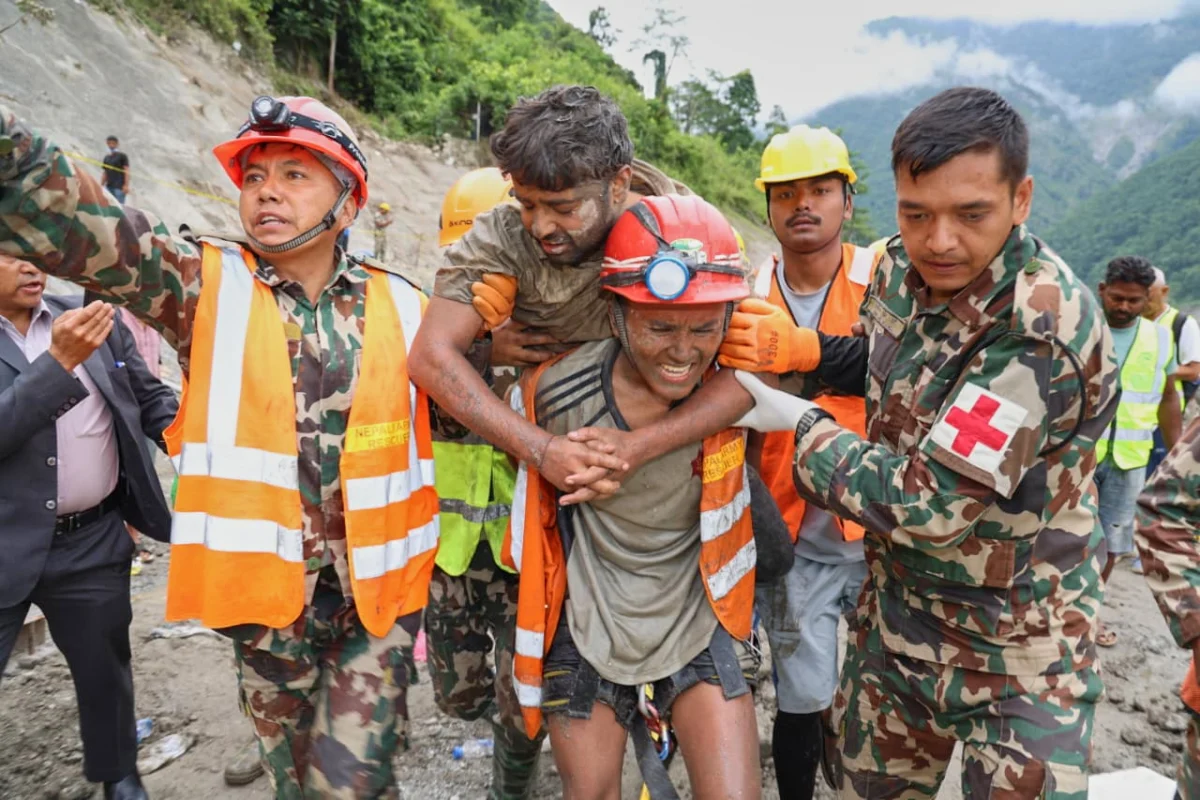
In a dramatic turn of events that has reignited hope across a grieving nation, Nepalese rescue teams successfully extracted two workers from an underground tunnel at the Trishuli-3A hydropower plant on Friday. The rescue comes nine days after a catastrophic flood, triggered by a suspected glacier collapse, ravaged the Himalayan region, leaving a trail of destruction that has claimed over a thousand lives and left thousands more missing. The discovery of the survivors has shifted the focus of the massive recovery operation, as authorities now believe dozens more may still be alive within the labyrinthine network of tunnels that define Nepal’s hydroelectric infrastructure.
The rescue operation began in the early hours of Friday morning in the Rasuwa district, a rugged mountainous area approximately 45 kilometers north of Kathmandu. Search teams, comprised of specialized Nepal Army units and local volunteers, reported hearing muffled voices echoing from deep within the subterranean access tunnels of the Trishuli-3A project. Utilizing sensitive acoustic equipment and thermal imaging, the teams were able to pinpoint the location of the trapped men, who had been surviving in total darkness and extreme humidity since the disaster struck on August 26.
Images released by the Nepal Army depicted the grueling nature of the extraction. Soldiers, caked in thick, grey silt, were seen carrying the survivors through narrow passages choked with debris. One worker, visibly exhausted and covered in mud, was carried on the back of a rescuer as others cleared a path through the wreckage of the plant’s mechanical wing. The two men, identified by officials as a mechanical foreman and a mechanical supervisor, were immediately provided with basic first aid before being airlifted by military helicopter to a specialized medical facility in the capital.
The Scale of the Subterranean Crisis
The rescue at Trishuli-3A has brought the plight of Nepal’s hydropower workforce into sharp focus. According to the Independent Power Producers Association of Nepal (IPPAN), the August 26 floods hit the energy sector with unprecedented ferocity. Current estimates suggest that approximately 900 workers remain unaccounted for across 12 different hydropower projects in the region. Of these, authorities believe roughly 500 individuals may be trapped in various tunnel systems that were submerged or sealed off by landslides during the initial surge.
At the Trishuli-3A plant alone, the situation remains dire. Association officials estimate that 115 workers are still missing within the specific tunnel complex where Friday’s survivors were found. The testimony of the rescued foreman has provided a glimmer of hope for the families of those missing; he reportedly told rescuers that he heard other voices further back in the tunnel system before the water levels stabilized.
Brigadier General Raja Ram Basnet, a spokesperson for the Nepal Army, confirmed that the search operation has been intensified following the rescue. "The fact that these two men survived for nine days in such conditions is nothing short of a miracle," Basnet stated. "It proves that air pockets exist and that the structural integrity of these tunnels has, in some places, held up against the pressure of the mud and water. Our mission now is to reach those pockets as quickly as possible."
Chronology of a Himalayan Catastrophe
The disaster began on the morning of August 26, 2026, when a massive ice shelf reportedly sheared off a glacier in the Langtang range. The resulting avalanche plummeted into a high-altitude glacial lake, causing a displacement wave that breached the natural moraine dam. What followed was a "Glacial Lake Outburst Flood" (GLOF) of historic proportions.
Within minutes, a wall of water, ice, and boulders roared down the Trishuli River valley. The timing was particularly devastating, as it coincided with the morning shift change at several major hydropower sites. The Trishuli-3A project, a critical component of Nepal’s national power grid, was hit directly. The floodwaters didn’t just overflow the banks; they carried thousands of tons of sediment that acted like liquid sandpaper, scouring away roads, bridges, and the external housing of the power plants.
By the evening of August 26, the scale of the tragedy began to emerge. Entire villages had been erased from the map. In the days that followed, the death toll climbed steadily. As of Friday, the Nepal Disaster Management Agency has confirmed 1,287 fatalities, with more than 5,000 people still officially listed as missing. The disaster also crossed international borders; Chinese state media outlet Xinhua reported on Friday that 31 people were killed and 531 remain missing on the Tibet side of the border, where the same glacial event caused flash flooding in the upper reaches of the river systems.
Economic and Infrastructural Fallout
The financial implications of the flood are staggering for a developing nation like Nepal. The disaster agency’s Friday estimate placed the damage to infrastructure and property at 387.5 billion Nepalese rupees, or approximately $2.5 billion USD. This figure represents a significant portion of the country’s annual GDP and threatens to derail years of economic progress centered on renewable energy.

Nepal has long pinned its economic future on its "white gold"—the vast hydroelectric potential of its Himalayan rivers. The 12 projects currently offline or damaged represent a substantial percentage of the nation’s total generating capacity. Trishuli-3A, for instance, is a major supplier of electricity to Kathmandu and surrounding industrial hubs. The destruction of these facilities has already led to widespread power rationing and has halted plans for energy exports to neighboring India and Bangladesh.
Bikram Timilsina, Nepal’s Communication Minister, addressed the economic crisis in a statement on social media, emphasizing that while the financial loss is immense, the priority remains the human cost. "We are facing a national emergency that touches every sector of our society," Timilsina wrote. "While we calculate the billions lost in concrete and turbines, our hearts are with the families of the 500 workers still beneath the earth. We are waiting for the rescue of more and more people."
Medical and Humanitarian Response
The two survivors rescued on Friday are currently under intensive care in Kathmandu. Amir Maharjan, the brother of one of the rescued workers, expressed the emotional roller coaster experienced by the families. "I can’t explain what we are feeling at the moment. We spent nine days mourning, thinking they were gone. We are just grateful to God," Maharjan told reporters as he rushed to the hospital.
However, the medical reality is sobering. A statement from the Prime Minister’s office indicated that while one survivor is stable, the second remains in critical condition. Nine days of isolation without adequate food, clean water, and exposure to the damp, cold environment of a mountain tunnel has left the men suffering from severe dehydration, hypothermia, and potential respiratory issues from inhaling silt-laden air.
The humanitarian response has been hampered by the same geography that makes the region so beautiful. Many of the affected hydropower sites are accessible only by air or by footpaths that have been obliterated. The Nepal Army has deployed nearly 10,000 personnel to the region, supported by international aid groups and technical experts from neighboring countries who are assisting with tunnel stability assessments.
Scientific Context: The Role of Climate Change
Geologists and climate scientists are pointing to the August 26 event as a stark warning of the increasing instability of the Himalayan region. The "Third Pole," as the Himalayas are often called due to their massive ice reserves, is warming at a rate significantly higher than the global average. This accelerated melting leads to the formation of unstable glacial lakes held back only by fragile natural dams of loose rock and ice.
"This was not a standard monsoon flood," said Dr. Hemant Sharma, a Himalayan geologist. "This was a structural failure of the landscape caused by thermal stress. As glaciers retreat, they leave behind high-risk environments. The infrastructure we build in these valleys—while necessary for green energy—must now be designed to withstand the ‘unthinkable’ events that are becoming our new reality."
The tragedy has sparked a debate within Nepal regarding the safety protocols of hydropower projects. Critics argue that while the tunnels are designed to withstand water pressure from within, they are not always equipped with the emergency exits, communication arrays, or survival chambers necessary for workers trapped by external geological disasters.
A Nation in Waiting
As the sun sets over the Rasuwa district, the hum of generators and the clatter of excavators continue to echo through the valley. The rescue of the two workers has transformed the atmosphere at the Trishuli-3A site from one of grim recovery to one of urgent, hopeful searching.
For the families of the 500 workers still believed to be underground, the events of Friday have provided a tether to hope. Every hour that passes makes the odds of survival slimmer, yet the miracle at Trishuli-3A serves as a reminder of the resilience of the human spirit and the dedication of the rescue teams who refuse to abandon their comrades.
The Nepalese government has declared a period of national mourning for those lost, but for the search teams on the ground, there is no time for ceremony. With hundreds of lives still hanging in the balance within the dark, damp confines of the earth, the race against time continues. The recovery of the two mechanical experts is a victory, but in a disaster that has claimed over 1,200 lives, it is a small light in a very large shadow.
