

NGAPE, Myanmar — In the Rakhine mountains of western Myanmar, a lonely highway lies under fog. Barely any traffic passes, a stark contrast to the vital artery it represents for regional energy security. This desolate stretch of road, part of the infrastructure supporting the China-Myanmar oil and gas pipelines, now threads through a landscape increasingly defined by conflict and displacement. The pipelines, a cornerstone of China’s Belt and Road Initiative and a critical energy import route, are becoming entangled in the intensifying internal strife that has gripped Myanmar since the 2021 military coup.
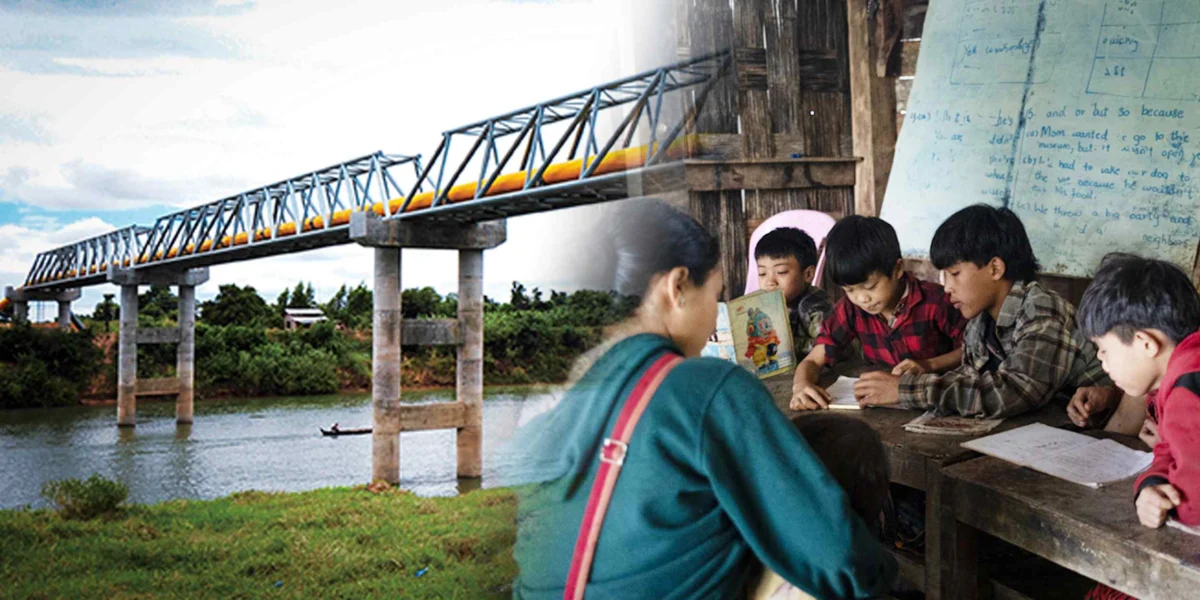
The oil pipeline, stretching from China’s Yunnan province to Myanmar’s Indian Ocean port of Kyaukphyu, is designed to bypass the chokepoint of the Strait of Malacca, offering China a more direct and secure energy supply. However, the very regions through which this crucial infrastructure passes are now flashpoints. The photo montage accompanying this report starkly illustrates this dichotomy: on one side, the imposing industrial presence of the oil pipeline, a symbol of geopolitical ambition; on the other, the human cost of the ongoing conflict, with children displaced by fighting in Rakhine State and Magway Region seeking education in makeshift camps for internally displaced people. This juxtaposition underscores the profound human impact of a conflict that threatens to destabilize a vital piece of global energy infrastructure.
The Geopolitical Significance of the China-Myanmar Pipelines
The China-Myanmar pipelines, officially inaugurated in 2017, consist of two parallel conduits: an oil pipeline with a capacity of 22 million tonnes per year and a gas pipeline with a capacity of 12 billion cubic meters per year. Their strategic importance to Beijing cannot be overstated. Prior to their completion, over 80% of China’s crude oil imports transited through the Strait of Malacca, a narrow waterway vulnerable to potential blockades or disruptions. The Myanmar pipelines offer China a crucial alternative, significantly enhancing its energy security and diversifying its import routes.
The project, a joint venture involving China National Petroleum Corporation (CNPC) and Myanmar Oil and Gas Enterprise (MOGE), was hailed as a win-win initiative, promising economic development for Myanmar and energy security for China. The Kyaukphyu Special Economic Zone, envisioned as a major deep-sea port and industrial hub, was a key component of this grand strategy, aiming to unlock economic potential for Myanmar’s underdeveloped western coast.
A Growing Shadow of Conflict
However, the optimistic vision has been increasingly overshadowed by the reality of Myanmar’s protracted internal conflict. The post-coup period has seen a resurgence and intensification of ethnic armed organizations (EAOs) and the emergence of People’s Defence Forces (PDFs) fighting against the ruling military junta. These resistance groups have increasingly targeted infrastructure perceived as supporting the regime, including projects with significant foreign investment.
While there have been no confirmed direct attacks on the primary pipelines themselves, the escalating violence in the surrounding regions, particularly in Rakhine and Magway, poses a significant threat. Reports from the ground indicate increased skirmishes and military operations in areas adjacent to the pipeline routes. The presence of armed groups, coupled with the junta’s counter-insurgency operations, creates an environment of instability that is antithetical to the safe and continuous operation of such critical infrastructure.
The Rakhine State, historically a region prone to ethnic tensions, has seen renewed fighting between the Arakan Army (AA), an ethnic Rakhine armed group, and the Myanmar military. The AA has been increasingly assertive, at times clashing with both the junta’s forces and, indirectly, impacting the security environment around the pipeline’s terminal at Kyaukphyu. Simultaneously, Magway Region, a key transit area for the pipelines, has become a hotbed for PDF activity, leading to frequent clashes.
Timeline of Escalation and Disruption
The trajectory of instability impacting the pipeline region can be traced through several key periods:
- Pre-coup (Prior to February 2021): While ethnic insurgencies were a persistent issue, the overall security environment allowed for the construction and initial operation of the pipelines. Diplomatic efforts focused on addressing local community concerns and environmental impacts.
- Post-coup (February 2021 onwards): The military coup triggered widespread protests and the formation of the National Unity Government (NUG) and its associated PDFs. This led to a significant escalation of internal conflict across the country.
- 2022-2023: Resistance groups began to gain ground in various regions, and attacks on infrastructure perceived as pro-junta or benefiting from foreign investment became more frequent. While direct attacks on the CNPC pipelines were not reported, the general insecurity in transit areas grew.
- Late 2023 – Early 2024: The conflict in Rakhine State intensified with the Arakan Army making significant territorial gains, leading to heightened military activity and displacement. Simultaneously, fighting in Magway Region also escalated, affecting the broader operational environment for the pipelines.
- Mid-2024 onwards: Concerns are growing about the long-term security of the pipelines as the conflict shows no signs of abating. The ability of CNPC and MOGE to conduct regular maintenance and ensure security along the entire length of the pipelines is increasingly challenged by the volatile situation.
Supporting Data and Human Impact
The human cost of this escalating conflict is stark and directly impacts the communities living along the pipeline routes. According to the United Nations Office for the Coordination of Humanitarian Affairs (OCHA), as of late 2023, over 2.6 million people had been displaced across Myanmar since the coup. Many of these displaced individuals are from regions like Rakhine and Magway, where the pipelines traverse.
The children pictured in the camp for internally displaced people represent a fraction of the immense human toll. Their education is disrupted, their futures uncertain, all occurring in the shadow of an energy lifeline that was meant to bring prosperity. Local communities, often caught between the military and various resistance groups, face immense hardship, including displacement, loss of livelihoods, and limited access to essential services. While the primary focus of international news often remains on the geopolitical implications, the ground reality for these communities is one of survival amidst a devastating conflict.
Furthermore, the environmental impact of such large-scale infrastructure projects, especially in a region prone to natural disasters and with limited regulatory oversight, is a perpetual concern. Any disruption or damage to the pipelines due to conflict could lead to significant environmental contamination, further exacerbating the plight of local populations and ecosystems.
Official Responses and Shifting Alliances
China has consistently advocated for stability and security in Myanmar, emphasizing the importance of the pipelines for its energy needs. Beijing has urged all parties to exercise restraint and ensure the safety of foreign investments and personnel. However, its diplomatic approach has been characterized by a delicate balancing act, maintaining relations with the military junta while also engaging, albeit indirectly, with some EAOs to ensure the unimpeded flow of energy.
The Myanmar military junta, facing mounting international pressure and internal resistance, has reiterated its commitment to protecting foreign investments and ensuring the security of the pipelines. However, its capacity to do so effectively is increasingly questioned amidst its struggle to control large swathes of territory.
EAOs and PDFs have issued statements and warnings regarding infrastructure projects, often framing them as symbols of the junta’s legitimacy or as conduits benefiting the military. While specific threats against the CNPC pipelines have not been widespread, the general sentiment and the increasing targeting of other forms of infrastructure suggest a growing risk.
The international community, while largely condemning the coup and imposing sanctions on the junta, has also expressed concerns about the security of the pipelines due to their global energy implications. However, a unified approach to ensuring their safety remains elusive.
Broader Implications for Regional Stability and Energy Security
The escalating conflict surrounding the China-Myanmar pipelines has several far-reaching implications:
- Geopolitical Leverage: The continued operation of the pipelines is crucial for China’s energy security. Any sustained disruption could force Beijing to seek alternative, potentially more expensive, routes, impacting global energy markets. This also provides China with significant leverage in its dealings with Myanmar.
- Regional Instability: The conflict in Myanmar is not confined to its borders. The instability along the pipeline routes could spill over, affecting neighboring countries and exacerbating regional security concerns. The humanitarian crisis, with millions displaced, also has regional implications.
- Economic Impact: The economic benefits envisioned for Myanmar, particularly through the Kyaukphyu SEZ, are severely jeopardized. The ongoing conflict deters foreign investment and hinders development, leaving local communities in a state of prolonged economic hardship. For China, a disruption to this energy route would necessitate increased reliance on other, potentially more politically sensitive, supply lines.
- Belt and Road Initiative (BRI): The China-Myanmar pipelines are a flagship project of the BRI. Their vulnerability and the ongoing conflict raise questions about the long-term viability and security of other BRI projects in unstable regions, potentially impacting China’s broader geopolitical ambitions.
- Humanitarian Crisis: The displacement and suffering of communities along the pipeline routes highlight the human cost of geopolitical ambitions and internal conflicts. The lack of security directly impedes humanitarian aid efforts and exacerbates the existing crisis.
The lonely highway under fog in the Rakhine mountains serves as a potent metaphor for the precarious state of the China-Myanmar energy lifeline. What was conceived as a strategic triumph of infrastructure and geopolitical foresight is now inextricably linked to the brutal realities of Myanmar’s ongoing civil war. The future of this vital energy corridor, and indeed the stability of the region, hinges on the resolution of a conflict that continues to exact a devastating toll on its people. The world watches, not just for the uninterrupted flow of oil, but for the safety and well-being of the communities caught in the crossfire.
