

The price of gold (XAU/USD) maintained a firm stance during the North American trading session, yet buyers encountered significant resistance at the $4,700 level, triggering a modest retracement below this key psychological threshold. Trading at $4,641, the precious metal registered a marginal decline of 0.2%, reflecting a market grappling with a confluence of factors including mixed US economic data and burgeoning hopes for a de-escalation of tensions in the US-Iran conflict. This intricate interplay of geopolitical shifts, domestic economic indicators, and technical market signals continues to shape gold’s near-term trajectory.
Geopolitical Undercurrents and Gold’s Safe-Haven Appeal
A pivotal driver behind gold’s recent consolidation and slight easing stems from improving geopolitical headlines, particularly concerning the Middle East. News reports, citing two US officials confirming President Trump’s announcement, indicated that the US Navy had successfully cleared the traffic separation scheme in the Strait of Hormuz. This development, initially reported by Axios, signifies a potential reduction in maritime risks within the critical waterway, which is a chokepoint for a significant portion of the world’s oil supply.
The Strait of Hormuz has historically been a flashpoint for US-Iran tensions. In recent memory, incidents involving tanker seizures, drone shoot-downs, and heightened naval presence have frequently elevated global risk perceptions, often leading investors to seek refuge in safe-haven assets like gold. For instance, in mid-2019, a series of attacks on oil tankers in the Gulf and the downing of a US drone by Iran sharply increased geopolitical premiums on gold. Conversely, any signs of de-escalation tend to dampen gold’s safe-haven allure, as the immediate threat of widespread conflict or disruption to global trade routes diminishes. The clearing of the traffic separation scheme, therefore, contributes to an environment where the perceived need for safe-haven hedging is reduced, allowing other market fundamentals to exert greater influence. This narrative of de-escalation comes at a time when the global economy is particularly sensitive to supply chain disruptions and energy price volatility.
Technical Indicators Suggest Overbought Conditions
From a technical perspective, the yellow metal’s bullish momentum has shown signs of stalling, with the Relative Strength Index (RSI) signaling overbought conditions. The RSI, a momentum oscillator that measures the speed and change of price movements, typically indicates that an asset is overbought when its reading surpasses the 70-mark. While gold has demonstrated resilience, its inability to decisively break above the $4,700 resistance level, combined with an elevated RSI, suggests that a period of consolidation or a minor pullback might be underway. Market analysts often interpret an overbought RSI as a precursor to a potential price correction, as buying pressure may temporarily exhaust itself.
The $4,700 mark itself acts as a significant psychological and technical resistance. Repeated failures to breach this level can reinforce its strength, potentially leading traders to take profits and contributing to downward pressure. The current trading behavior, characterized by sideways movement for the second consecutive day, further underscores the market’s indecision and the struggle between lingering bullish sentiment and emerging bearish technical signals.
Mixed US Economic Data Presents a Nuanced Picture
The domestic economic landscape in the United States continues to present a mixed bag, offering little clear directional guidance for the gold market. Recent data releases have provided a nuanced view of the economy’s health, influencing perceptions of future monetary policy.
On the positive side, US housing data showed a slight improvement. Building Permits in July rose by 4.3% to an annualized rate of 1.433 million units. This figure comfortably surpassed the previous month’s -2.6% contraction and analyst estimates of a 5% increase. An uptick in building permits is generally viewed as a forward-looking indicator for the housing market, suggesting increased construction activity and potential economic growth. A robust housing sector often implies underlying consumer confidence and economic stability.
Similarly, the ADP Employment Change, a gauge of private sector employment, indicated a healthier labor market. The four-week average came in at 11.75K, exceeding the previous print of 9.5K. While the ADP report is not always a perfect predictor of the official Non-Farm Payrolls (NFP) report, it provides an early indication of hiring trends. An improving labor market is typically a positive sign for economic expansion, potentially reducing the need for aggressive monetary easing.
However, the Conference Board Consumer Confidence Index painted a less optimistic picture, missing estimates by coming in at 90.2, below the expected 90.2. Although the headline figure matched the estimate, the detailed breakdown indicated that households perceived only a slight improvement in business and jobs conditions in August. Consumer confidence is a critical indicator of consumer spending, which accounts for a significant portion of US GDP. A weaker-than-expected confidence reading can signal concerns about future economic prospects, potentially leading to reduced spending and slower growth. The slight improvement in perceptions of business and jobs was not enough to offset broader concerns, highlighting lingering uncertainties among American households.
Federal Reserve’s Stance and Market Expectations
The Federal Reserve’s monetary policy trajectory remains a central focus for gold investors. Recent statements from Fed officials, coupled with market pricing of future rate hikes, underscore the complex environment in which the central bank is operating.
Boston Fed President Susan Collins adopted a hawkish stance, emphasizing that inflation remains "too great" and voicing concern about the Fed’s primary mandate of price stability. She acknowledged that the labor market aligns with full employment and noted that the economy is expanding at a near-trend rate. Collins’ comments reflect a segment within the Fed that prioritizes taming inflation, even if it means maintaining a tighter monetary policy for longer. Her insistence on price stability underscores the central bank’s commitment to bringing inflation down to its 2% target, a goal that has proven challenging in recent times. The "full employment" and "near-trend growth" observations suggest that the economy might be robust enough to withstand further tightening without significant damage, providing the Fed with room to maneuver.
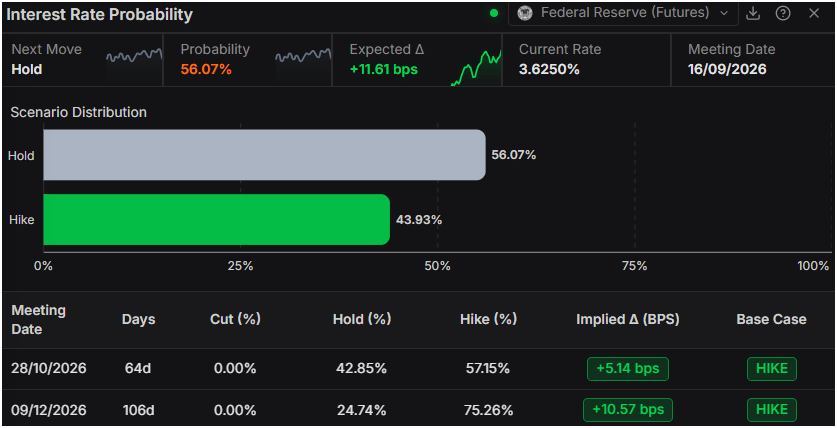
Despite hawkish rhetoric from some officials, money markets remain skeptical about the likelihood of a rate hike at the upcoming September Federal Open Market Committee (FOMC) meeting. According to data from Prime Terminal, the odds for a 25-basis-point rate hike are near 43%, while the probability of keeping rates steady stands at 57%. This divergence between some Fed officials’ hawkish comments and market expectations highlights the cautious approach investors are taking. The market is keenly awaiting more conclusive evidence, particularly on inflation, before fully pricing in another rate increase. Gold, being a non-yielding asset, typically benefits from lower interest rates as the opportunity cost of holding it decreases. Conversely, higher interest rates make interest-bearing assets like US Treasuries more attractive, potentially drawing capital away from gold.
Upcoming Economic Calendar and Fed Leadership
The coming days are packed with crucial economic releases and speeches that could significantly influence market sentiment and, by extension, gold prices. Eyes are firmly fixed on the release of the Core Personal Consumption Expenditures (PCE) Price Index, which is the Federal Reserve’s preferred inflation gauge. This data point offers a comprehensive measure of consumer inflation, excluding volatile food and energy prices, and its trajectory is paramount to the Fed’s policy decisions. A higher-than-expected Core PCE could reinforce hawkish sentiments and increase the probability of future rate hikes, potentially pressuring gold. Conversely, a softer reading might bolster market skepticism about further tightening, offering support to the precious metal.
Following the PCE data, attention will shift to the highly anticipated speech by the new Fed Chair, Kevin Warsh, at the prestigious Jackson Hole Symposium. Warsh, a former Federal Reserve Governor, is known for his nuanced views on monetary policy and financial markets. His address at Jackson Hole, a gathering of central bankers, economists, and financial market participants from around the world, will be scrutinized for any clues regarding the future direction of US monetary policy. Any hints about the Fed’s inflation outlook, labor market assessment, or overall economic strategy could trigger significant market reactions. The symposium has historically been a platform for major policy announcements and shifts in central bank guidance, making Warsh’s speech a pivotal event.
Beyond these key events, the US economic schedule will also feature other significant data points, including Durable Goods Orders, Gross Domestic Product (GDP) figures, and Initial Jobless Claims data. Durable Goods Orders provide insights into manufacturing activity and business investment, while GDP offers a comprehensive snapshot of overall economic growth. Initial Jobless Claims, a weekly measure of new unemployment benefit applications, serve as a timely indicator of labor market health. Each of these releases will contribute to the broader economic narrative, influencing investor perceptions of the US economy’s strength and the Fed’s potential policy responses.
XAU/USD Technical Outlook: Key Levels to Watch
The technical picture for gold indicates that the precious metal is at a critical juncture, struggling to find clear direction. The inability of buyers to clear the $4,700 resistance has exacerbated a retracement below the $4,650 level. The Relative Strength Index (RSI) is currently aiming lower but remains above the 70 overbought threshold. Should the RSI decisively fall below this level, it could signal a more significant shift in momentum, potentially leading XAU/USD to dive further and challenge key support levels.
Immediate support for gold is identified at the psychological $4,600 mark. A break below this level could open the door for a test of the 200-day Simple Moving Average (SMA), which currently sits at $4,519. The 200-day SMA is a widely watched long-term trend indicator, and a breach of this level would typically be interpreted as a bearish signal, suggesting a potential reversal of the broader uptrend. Further downside targets include the $4,500 psychological level, followed by the 100-day SMA at $4,379. The 100-day SMA represents another crucial dynamic support level that, if broken, would confirm significant selling pressure.
For a resumption of the bullish trend, XAU/USD must convincingly reclaim and hold above the $4,700 resistance. A successful breakout above this level would signal renewed buying interest and could pave the way for a move towards the May 7 swing high of $4,764. Surpassing this level would then bring the $4,800 psychological barrier into focus. Should the momentum persist and these resistances be overcome, the next significant area of interest for gold bulls would be the $5,000 mark, a major psychological milestone that would represent a substantial rally from current levels.
Gold’s Enduring Role in the Global Economy
Gold has maintained a central role in human history, serving as a fundamental store of value and a medium of exchange across civilizations. Today, beyond its aesthetic appeal and use in jewelry, the precious metal is widely regarded as a quintessential safe-haven asset. During periods of economic uncertainty, geopolitical instability, or financial market turmoil, investors often flock to gold to preserve capital, as it is perceived to be less susceptible to the volatility that affects other asset classes.
Furthermore, gold is widely recognized as an effective hedge against inflation and depreciating currencies. Unlike fiat currencies, which are subject to the policies of specific issuers or governments, gold’s value is intrinsic and not directly tied to any single economy’s health or central bank’s actions. This independence makes it an attractive asset when confidence in traditional currencies or government bonds wavers.
Central banks globally are among the largest holders of gold, consistently adding to their reserves. Their motivations often include supporting their national currencies during turbulent times and diversifying their reserve assets. High gold reserves can bolster a country’s perceived solvency and economic strength. According to data from the World Gold Council, central banks collectively added a staggering 1,136 tonnes of gold, valued at approximately $70 billion, to their reserves in 2022. This marked the highest yearly purchase since records began, highlighting a strategic shift among monetary authorities. Notably, central banks from emerging economies such as China, India, and Turkey have been rapidly increasing their gold holdings, signaling a broader trend of de-dollarization and a move towards more diversified, resilient reserve portfolios.
Gold’s price dynamics are also intimately linked to its inverse correlation with the US Dollar (USD) and US Treasuries, both major reserve and safe-haven assets. When the US Dollar weakens, gold typically tends to strengthen, as it becomes cheaper for holders of other currencies and enhances its appeal as an alternative store of value. Conversely, a strong Dollar tends to exert downward pressure on gold prices. Similarly, gold often exhibits an inverse correlation with risk assets like equities. A robust stock market rally tends to divert investment away from gold, while significant sell-offs in riskier markets often favor the precious metal as investors seek security.
Ultimately, the price of gold is influenced by a wide array of factors. Geopolitical instability or fears of a deep recession can quickly trigger a surge in gold prices due to its safe-haven status. As a yield-less asset, gold generally performs better in environments of lower interest rates, as the opportunity cost of holding it decreases. Conversely, a rising cost of money, driven by higher interest rates, typically weighs down on the yellow metal. However, most significant moves in gold prices are often dictated by the behavior of the US Dollar, given that gold is universally priced in dollars (XAU/USD). A strong Dollar tends to keep gold prices in check, whereas a weaker Dollar is likely to provide a significant boost to the precious metal. The current market environment, characterized by evolving geopolitical landscapes, mixed economic signals, and uncertain monetary policy trajectories, ensures that gold will remain a highly watched asset for investors worldwide.
