

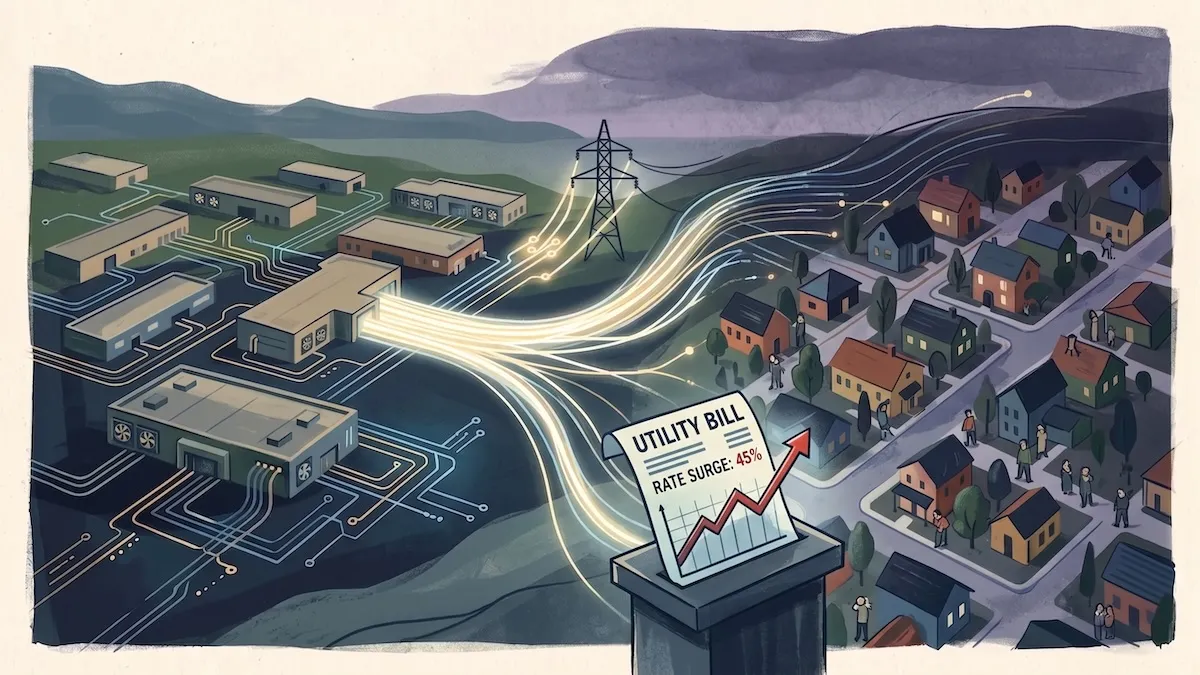
The rapid proliferation of data centers across the United States has introduced a new and complex variable into the real estate market, forcing homeowners and agents to look beyond traditional metrics of property value. While much of the public discourse surrounding these massive industrial facilities has focused on localized issues—such as noise pollution, the obstruction of scenic views, and land-use conflicts—a more systemic financial threat is emerging: the potential for data centers to drive up monthly residential utility bills. As tech giants like Amazon, Google, and Microsoft race to build the infrastructure necessary to support artificial intelligence and cloud computing, the cost of the electricity required to power these "digital factories" is increasingly being scrutinized by legal experts, consumer advocates, and real estate professionals.
The core of the issue lies in the unprecedented scale of energy consumption required by modern data centers, which can consume as much electricity as a medium-sized city. This demand is colliding with a traditional utility business model that often socializes the cost of new infrastructure across its entire customer base. According to Ari Peskoe, director of the Electricity Law Initiative at the Harvard Law School Environmental and Energy Law Program, the fundamental question facing regulators today is who should bear the financial burden when a utility builds new power plants, transmission lines, and substations to serve the tech industry. In a 2025 report titled "Extracting Profits from the Public: How Utility Ratepayers Are Paying for Big Tech’s Power," Peskoe and co-author Eliza Martin argue that current rate structures may be inadvertently shifting the costs of serving large technology companies onto residential homeowners and renters.
The Mechanics of Utility Rate-Making and Cost Socialization
To understand how a data center in a different ZIP code could affect a homeowner’s monthly expenses, it is necessary to examine the three primary components of an electric bill: generation, transmission, and distribution. Generation refers to the actual production of electricity at power plants; transmission involves moving that power over long distances via high-voltage lines; and distribution is the local delivery of power to homes and businesses.
In the traditional regulatory framework, utilities are granted monopolies over specific service territories. In exchange for this monopoly, they are required to provide reliable service to all customers. To fund the massive capital investments required for infrastructure, utilities typically "socialize" these costs, spreading them across all consumers. However, the sheer volume of demand from data centers—often hundreds of megawatts for a single site—requires upgrades to the grid that would not otherwise be necessary. If a utility spends billions of dollars on new transmission lines to reach a data center cluster, those costs are frequently added to the rate base, meaning every customer in the territory pays a portion of the bill.
J.P. Blackwood, a spokesperson for the Ohio Consumers’ Counsel (OCC), notes that this surge in demand is already having a measurable impact on regional markets. In the PJM Interconnection—the regional transmission organization that coordinates the movement of wholesale electricity in all or parts of 13 states and the District of Columbia—data center growth has been identified as a primary driver of rising prices. In a recent capacity auction, which ensures there is enough power to meet future demand, revenue requirements surged by $7.3 billion, an 82% increase, totaling $16.1 billion. These wholesale costs eventually trickle down to the retail level, affecting the monthly "affordability equation" for households already struggling with high mortgage rates and insurance premiums.
A Chronology of the Data Center Boom and Regulatory Response
The tension between data center development and residential costs has evolved rapidly over the last decade, moving from a niche concern to a central regulatory challenge.
- 2010–2018: The Rise of Cloud Computing. Data centers began clustering in specific regions, such as Northern Virginia’s "Data Center Alley," drawn by tax incentives and proximity to fiber-optic hubs. During this era, they were largely viewed as economic engines that provided significant tax revenue without placing heavy demands on local schools or roads.
- 2019–2022: The Scaling Phase. The size of individual data center projects grew from 20-megawatt facilities to "hyperscale" campuses exceeding 100 megawatts. Concerns began to emerge regarding the "stranded investment" problem—where a utility builds infrastructure for a tech company that might later vacate the site or reduce its usage, leaving residential customers to pay for the idle equipment.
- 2023–Present: The AI Explosion. The advent of generative AI increased power density requirements significantly. Data centers now require specialized cooling and vastly more electricity than previous generations of servers. This has led to a flurry of new regulatory filings in states like Ohio, Georgia, and Virginia, as consumer advocates push for "tariffs" that force data centers to pay a larger share of infrastructure costs upfront.
Regional Case Studies: Divergent Approaches to Cost Protection
States have taken vastly different approaches to mitigating the impact of data centers on residential ratepayers, creating a patchwork of protections for homeowners.
Ohio: The AEP Data-Center Tariff
In Ohio, regulators and the utility AEP Ohio have implemented a specific data-center tariff designed to prevent speculative development from burdening the public. Under this framework, new large-scale data centers must commit to paying for at least 85% of their contracted electric capacity for up to 12 years, regardless of whether they actually use that much power. This "take-or-pay" model ensures that if a tech company cancels a project or scales back operations, it remains financially responsible for the substations and lines built specifically for its use. This protects remaining customers from the "stranded-investment" risk.
Virginia: Creating a Separate Rate Class
As the global epicenter of data centers, Virginia has moved toward more explicit cost-segmentation. The Virginia State Corporation Commission established the GS-5 rate class specifically for hyperscale users. Starting in 2027, large-load customers in this class must commit to at least 14 years of service and pay for 85% of the transmission and distribution costs incurred to serve them. This move was a direct response to fears that the rapid expansion of the digital economy was being subsidized by the state’s residential residents.
Georgia: The Transparency Conflict
In Georgia, the situation is more contentious. Georgia Power has argued that data center growth actually benefits existing customers by spreading fixed costs across a larger base of electricity sales. The company has frozen its base rates through 2028, claiming its large-load framework ensures tech companies pay their fair share. However, researchers like Peskoe remain skeptical, citing a lack of transparency. Many utilities negotiate "side deals" or confidential agreements with tech companies that are not disclosed to the public, making it difficult for consumer advocates to verify if the tech giants are truly covering the full cost of their impact on the grid.
Beyond Electricity: The Compounding Issue of Water Scarcity
While electricity costs are a primary concern for the future, the immediate impact on real estate is often felt through water usage. Data centers require millions of gallons of water daily for cooling purposes, a demand that can strain local aquifers and municipal systems.
In Granbury, Texas, real estate professionals are reporting that water availability has become a "make-or-break" factor in property transactions. Bernadine Anderson, a local Realtor and appraiser, notes that as of July 1, new statewide disclosure requirements have gone into effect, forcing sellers to provide detailed information about their water sources and well depths. In rural counties like Parker County, minimum acreage requirements for water wells are being strictly enforced to prevent over-extraction, a direct consequence of industrial demand competing with residential needs.
The promise of "job creation," often used by developers to gain local approval, is also being questioned. Jerry Allen, a Realtor with eXp Realty and a member of the Granbury planning and zoning commission, argues that while construction creates temporary employment, a finished data center requires very few employees to maintain. "It doesn’t take very many people to babysit a bunch of servers," Allen said, highlighting a growing sentiment that the long-term economic benefits to the local community may not outweigh the strain on resources.
Implications for the Real Estate Industry and Homeownership
For real estate agents, the data center boom represents a shift in how "affordability" must be calculated. Traditionally, agents have focused on the "PITI" acronym—Principal, Interest, Taxes, and Insurance. However, in regions where data centers are rapidly expanding, "Utilities" must now be considered a volatile fifth pillar of that equation.
A $50 monthly increase in electricity costs, while seemingly small, adds $600 a year to the cost of homeownership. For a household already stretched thin by inflationary pressures, such increases can affect the long-term viability of remaining in a home. Furthermore, the lack of transparency in utility-tech agreements means that these costs are often "invisible" until they appear on a monthly statement, making it difficult for buyers to forecast their future expenses accurately.
There is also the "flip side" to consider, as seen in Loudoun County, Virginia. The massive concentration of data centers there has generated enough tax revenue to allow the county to reduce property tax rates for residents. This creates a complex trade-off: a homeowner might see their property tax bill decrease even as their utility bill rises. The net effect on the cost of living depends entirely on local governance and the specific regulatory rules governing the local utility.
Conclusion: A Market in Flux
The future of the data center industry remains an unknown variable. With over a trillion dollars in investment projected for the coming year, the sector is in a period of unprecedented expansion. However, experts like Peskoe warn that the "bubble" could eventually pop, or technological shifts could render current infrastructure obsolete.
For the real estate market, the message is one of cautious due diligence. Agents and buyers in high-growth corridors must now ask questions that were once irrelevant to a residential transaction: What is the local utility’s plan for infrastructure expansion? Are there "take-or-pay" protections in place for residential ratepayers? How will the local water table handle five new industrial neighbors?
As the digital and physical worlds continue to merge, the cost of powering the internet is no longer a corporate expense hidden in a Silicon Valley ledger. It is becoming a localized reality, reflected in the monthly bills and property disclosures of homeowners across the American landscape. The "pricing wildcard" of data centers is here to stay, and its impact on housing affordability is only beginning to be understood.
