

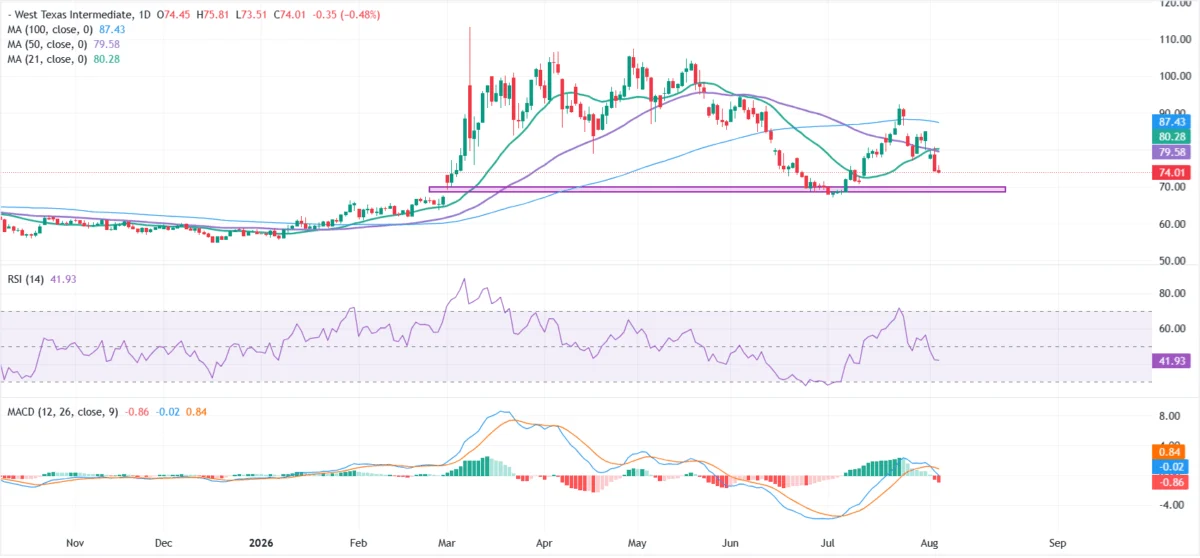
West Texas Intermediate (WTI) Crude Oil found itself navigating a complex confluence of geopolitical uncertainty and an unexpected surge in U.S. inventories on Wednesday, keeping prices under pressure. Hovering near three-week lows around $74 per barrel at the time of reporting, the commodity’s immediate trajectory is heavily influenced by the protracted negotiations surrounding commercial shipping through the critical Strait of Hormuz and the latest U.S. supply data. The market’s cautious stance reflects a persistent geopolitical risk premium, which, despite bearish signals, continues to underpin prices and limit the potential for a more significant downturn.
The Strait of Hormuz Conundrum: A Critical Geopolitical Flashpoint
The primary geopolitical factor influencing crude prices remains the delicate situation surrounding the Strait of Hormuz. This narrow waterway, connecting the Persian Gulf to the open ocean, is arguably the world’s most strategically important oil chokepoint. An estimated 20-30% of the world’s seaborne crude oil, along with a significant portion of liquefied natural gas (LNG), passes through the Strait daily, making its security paramount to global energy markets. Any disruption, perceived or real, sends ripples of anxiety across trading floors worldwide.
Recent developments indicate a potential, albeit fragile, pathway towards de-escalation. Iran and Oman have reportedly reached an understanding regarding the geographic coordinates for a proposed shipping route through the Strait. Iran’s Foreign Ministry confirmed that a joint statement detailing this understanding is in the final stages of review and drafting. However, this progress is contingent on "third parties" refraining from interference, a condition that immediately raises concerns among market participants and international observers. An informed source, speaking to Fars News, cautioned that an agreement between Iran and Oman would not automatically guarantee the reopening of the Strait, emphasizing that separate arrangements, including the fulfillment of "US commitments," would still be necessary.
Historical Context and "US Commitments"
The reference to "US commitments" points to the broader, long-standing tensions between Iran and the United States, particularly concerning sanctions and the defunct Joint Comprehensive Plan of Action (JCPOA), commonly known as the Iran nuclear deal. Since the US withdrawal from the JCPOA in 2018 and the subsequent re-imposition of sanctions, Iran has periodically threatened to impede shipping through the Strait in response to what it views as economic warfare. This history includes instances of tanker seizures, naval confrontations, and heightened military readiness in the region, all contributing to a volatile environment that sustains a geopolitical risk premium in oil prices.
Analysts suggest that "US commitments" likely refer to a demand from Iran for sanctions relief or guarantees against future US interference in its maritime activities, potentially linked to broader diplomatic efforts to de-escalate regional tensions or revive aspects of the nuclear accord. Oman, a historically neutral and diplomatic actor in the region, often plays a mediating role in such complex negotiations, leveraging its strong ties with both Iran and Western powers. While the agreement on coordinates marks a technical step forward, the political hurdles, particularly those involving the US, remain substantial and are likely to prolong the period of uncertainty. Until these intricate political and security arrangements are definitively resolved and commercial shipping demonstrably resumes without incident, the inherent geopolitical risk will continue to limit any significant downside for crude oil.
US Crude Inventories: An Unexpected Surge Amidst Shifting Demand
Adding to the downward pressure on WTI prices was the latest data from the U.S. Energy Information Administration (EIA). The EIA reported an unexpected build in Crude Oil inventories, rising by a substantial 2.479 million barrels. This figure sharply contrasted with market expectations, which had predicted a decline of 1.5 million barrels. The surprise increase follows a significant draw of 7.167 million barrels in the preceding week, highlighting the volatile nature of the US inventory landscape.
The unexpected inventory build suggests a potential weakening in domestic demand, an increase in imports, or a slowdown in refinery activity. Typically, a build in inventories indicates that supply is outstripping demand, which is fundamentally bearish for oil prices. While the previous week’s large draw suggested robust demand or tighter supply, this week’s data points to a potential shift in dynamics. Factors contributing to such an unexpected rise could include:
- Seasonal Refinery Maintenance: Refineries often undergo maintenance during certain periods, reducing their crude intake and leading to an accumulation of stocks.
- Fluctuations in Imports/Exports: Changes in global trade flows can significantly impact domestic inventory levels.
- Slower Domestic Demand: Economic slowdowns or shifts in consumer behavior can reduce demand for refined products, indirectly leading to higher crude stocks if refineries cut back on processing.
- Strategic Petroleum Reserve (SPR) Activity: While the SPR is not directly included in commercial inventories, its release or replenishment strategies can influence market perceptions and overall supply balances.
This sudden reversal in inventory trends presents a puzzle for traders attempting to gauge the true strength of U.S. oil demand. While one week’s data point does not establish a definitive trend, it contributes to market uncertainty, especially when combined with broader concerns about global economic growth.
Global Oil Market Dynamics and Price Pressures
WTI Crude Oil serves as a crucial benchmark for the global oil market, particularly for "light sweet crude" sourced primarily from the United States. Its price is influenced by a multitude of factors beyond immediate geopolitical events and inventory reports. These include global economic health, OPEC+ production policies, and the value of the U.S. Dollar.
OPEC+ Influence and Production Policies
The Organization of the Petroleum Exporting Countries and its allies (OPEC+), a powerful cartel comprising 23 oil-producing nations, plays a pivotal role in managing global oil supply. Through twice-yearly meetings and ad-hoc consultations, OPEC+ members decide on collective production quotas, directly impacting the global supply-demand balance. When OPEC+ decides to cut production, it aims to tighten supply, typically pushing oil prices higher. Conversely, an increase in production quotas tends to ease supply, exerting downward pressure on prices. Recent OPEC+ decisions have largely favored supply cuts to stabilize the market amidst concerns about global demand, a strategy that has provided a floor for oil prices even as other bearish factors emerge. The market constantly monitors OPEC+ rhetoric and actions for clues on future supply policies.

Global Demand Outlook and Economic Headwinds
Global economic growth is a primary driver of oil demand. Concerns about a slowdown in major economies, particularly China, Europe, and the United States, weigh heavily on the demand outlook. China, as the world’s largest crude importer, faces challenges in its property sector and domestic consumption, leading to revised-down demand forecasts. Europe grapples with inflation and potential recessionary pressures, while the U.S. navigates higher interest rates aimed at curbing inflation. Should these economic headwinds persist or intensify, global oil demand could weaken further, adding sustained downward pressure on prices. International energy agencies, such as the IEA and OPEC, regularly publish demand forecasts, which serve as critical indicators for market sentiment.
The Role of the US Dollar
Oil, being predominantly traded in U.S. Dollars, has an inverse relationship with the greenback’s value. A stronger U.S. Dollar makes oil more expensive for buyers holding other currencies, potentially dampening demand and pushing prices down. Conversely, a weaker Dollar can make oil more affordable, stimulating demand and supporting prices. Recent movements in the U.S. Dollar Index (DXY), driven by factors such as interest rate differentials and global economic sentiment, therefore, have a tangible impact on WTI prices.
Reactions and Expert Perspectives
The dual pressures on WTI have elicited cautious responses from various stakeholders. The Iranian Foreign Ministry’s emphasis on "third parties" avoiding interference underscores the complex political dimension of the Strait of Hormuz issue. This stance suggests that Iran views the Strait’s status as part of a broader negotiation, possibly linked to its economic and security grievances with Western powers.
Energy analysts generally agree that the geopolitical risk premium associated with the Strait of Hormuz is unlikely to dissipate quickly. "Even with a technical understanding between Iran and Oman, the political landscape is riddled with potential tripwires," noted one geopolitical risk consultant. "The explicit mention of ‘US commitments’ means this isn’t just about safe passage; it’s about a broader diplomatic game that could drag on."
Regarding the EIA inventory data, market strategists are attempting to discern whether the unexpected build is a one-off anomaly or the beginning of a trend indicating softening demand. "The magnitude of the inventory build, especially against expectations of a draw, raises questions about underlying demand strength in the U.S.," commented a commodities analyst from a major investment bank. "While one week doesn’t make a trend, it certainly adds to the bearish sentiment fueled by global economic concerns." These analysts anticipate continued volatility, with significant price movements tied to any concrete developments on the Hormuz front and subsequent EIA reports.
Broader Implications for Energy Security and Economy
The current situation carries significant implications for global energy security and the broader economy. For consumers, sustained volatility in crude oil prices directly translates into fluctuating fuel costs, impacting transportation, logistics, and ultimately, inflation. Businesses, particularly those in shipping, aviation, and manufacturing, face increased operational costs and planning uncertainties.
From a geopolitical perspective, the Strait of Hormuz remains a critical test of international diplomacy and regional stability. A successful, lasting resolution would not only ease oil market anxieties but also potentially pave the way for broader de-escalation in the Middle East. Conversely, any renewed escalation or failure to secure stable passage could trigger a sharp spike in oil prices, with severe economic repercussions worldwide. The interplay between U.S. energy policy, OPEC+ decisions, and Middle Eastern geopolitics will continue to shape the global energy landscape for the foreseeable future, demanding vigilant monitoring from policymakers, investors, and consumers alike.
Technical Analysis of WTI Crude Oil
From a technical standpoint, the near-term bias for WTI Crude Oil remains distinctly bearish. The price continues to trade well below its key Simple Moving Averages (SMAs) – specifically the 21-day, 50-day, and 100-day SMAs – a classic indicator of downward momentum. This alignment suggests that sellers have maintained control over recent trading sessions, pushing prices lower.
Momentum indicators further reinforce this corrective tone. The Relative Strength Index (RSI), a gauge of price momentum, is currently lingering below the neutral 50 mark, positioned around 42. An RSI reading below 50 typically indicates that the asset is experiencing more downward price momentum than upward. Similarly, the Moving Average Convergence Divergence (MACD) indicator is staying below the zero line with a negative reading. The MACD’s position below zero signals that the short-term average is below the long-term average, confirming a bearish trend and suggesting that selling pressure is still prevalent.
Looking at potential resistance levels, initial hurdles for any recovery attempt are observed at the 50-day SMA, which is currently near $79.58. Closely following this is the 21-day SMA at $80.27. These two moving averages form a critical supply zone. Should the price manage to approach this area, it is likely to encounter significant selling interest, which could cap any extension of a recovery. A more distant, but equally important, barrier is the 100-day SMA, positioned higher up at $87.43. A breach of this level would signal a more substantial shift in sentiment, but it remains a considerable challenge under current conditions.
On the downside, the immediate support for WTI is found within the $67.00-$70.00 zone. This range represents a crucial psychological and technical floor. A decisive break below this area would be a significant bearish signal, potentially opening the door to a deeper decline towards lower price levels, as it would imply a loss of established support and could trigger further selling pressure from market participants. Traders will closely monitor this support zone for signs of either stabilization or a further breakdown in price.
