

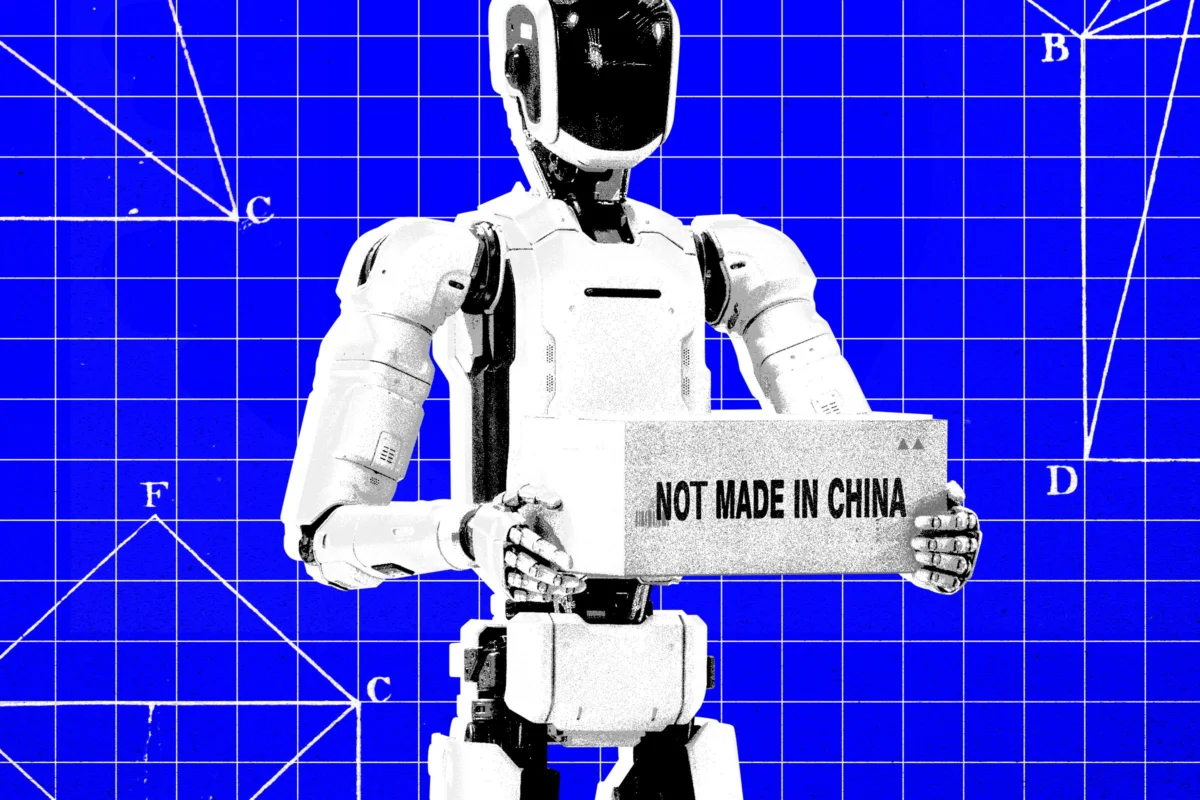
In a significant move with far-reaching implications for the global robotics industry, U.S. regulators last week imposed a ban on the importation of a wide array of Chinese-made robots. This decision, driven by escalating national security concerns, has created an unexpected opening for companies like Ati Robotics, an Indian firm that has strategically positioned itself to capitalize on the shift away from Chinese components. Saurabh Chandra, the founder of Ati Robotics, believes his company’s robots utilize fewer Chinese parts than nearly any other robotics firm operating within the United States, a claim that now resonates with increased urgency in the market.
The landscape of robotics investment has been experiencing an unprecedented surge. According to PitchBook, which meticulously tracks venture capital flows, this year has witnessed record highs in both the volume of deals and the total capital invested in robotics startups. However, a substantial portion of these burgeoning companies are primarily focused on software development. Consequently, they remain heavily reliant on Chinese suppliers for their essential hardware components. The Federal Communications Commission’s (FCC) recent decision to prohibit the import of new models of human-like robots, commonly known as humanoids, and other advanced robotic devices originating from China, presents a formidable challenge to many smaller U.S. robotics firms. Yet, for agile and strategically positioned businesses like Ati Robotics, this regulatory action is poised to become a catalyst for growth.
The Genesis of Ati Robotics and its Strategic Diversification
Ati Robotics was established in 2017 with an initial focus on developing motors specifically for the burgeoning self-driving car industry. However, the company soon pivoted its attention, zeroing in on the development and manufacturing of its own autonomous robots. Their product line now includes robust machines such as tuggers and pallet movers, designed to efficiently transport substantial loads of materials within large industrial facilities like warehouses and factories.
A key differentiator for Ati Robotics has been its unwavering commitment to developing its own proprietary hardware. This approach, while initially met with caution by some of Chandra’s advisors due to its inherent expense and complexity, has proven to be a prescient strategy. By controlling its hardware development, Ati has naturally minimized its dependence on Chinese supply chains. This foresight has positioned the company favorably in the current geopolitical and regulatory climate.
The fruits of this strategic decision are already evident. Ati Robotics currently has several hundred robots deployed and operational across various warehouses and factories, serving a customer base that exceeds fifty clients. The company is also poised to introduce its first humanoid robot later this year. This advanced machine is designed to handle the demanding task of moving heavy bins within industrial environments, further showcasing Ati’s commitment to developing sophisticated robotic solutions.
Navigating the Supply Chain: A Conversation with Saurabh Chandra
In an exclusive interview with WIRED last week, Saurabh Chandra elaborated on Ati Robotics’ deliberate strategy to circumvent reliance on Chinese manufacturing, while simultaneously maintaining a competitive edge in both price and performance against industry leaders.
WIRED: Developing in-house hardware is a significant financial undertaking. How has Ati Robotics managed to sustain this expensive endeavor?
Saurabh Chandra: Our research and development operations are strategically located in Bangalore, India, which provides a substantial advantage in terms of labor costs. At the time of our pivot, Bangalore was experiencing a significant revolution in the electric vehicle (EV) sector, particularly in the two-wheeler and three-wheeler segments. It turned out that the specifications and power profiles of the vehicles being developed for this booming EV market bore a striking resemblance to the requirements for the motors and components we needed for our robotics industry.
We were able to leverage the existing components and the burgeoning supply chain that was being established for these electric vehicles. Automotive-grade parts are typically characterized by high reliability and are produced in massive volumes, which inherently makes them both excellent in quality and highly cost-efficient. While we did need to engage in engineering efforts with some of these automotive vendors to adapt their parts for robotic applications, the effort paid off significantly. Once we achieved this adaptation, it represented a major win for us.
WIRED: You’ve mentioned that some of your robot models are free from Chinese components, while others are not entirely. Could you elaborate on this?
Saurabh Chandra: Our fleet exhibits varying degrees of what I would term "supply chain resiliency." Two of our most popular models – the 10,000-pound tugger and the pallet mover – utilize a remarkably small number of components sourced from China. These machines are designed for the critical task of transporting trolleys, moving raw materials from storage to the factory floor, or transferring them between different process points within a facility.
However, even with our advanced humanoid robot, certain components are manufactured domestically. For instance, the entire arm assembly is produced here in Bangalore, as is the actuator. Nevertheless, for specific high-precision parts like harmonic drives, we currently still source them from China. Similarly, for certain frameless motors, our reliance on Chinese suppliers persists, at least for the present.
The battery cells themselves are also currently sourced from China. But it is important to note that we have the flexibility to procure these cells from other regions, such as South Korea or Japan, should the need arise. These are what we consider passive components, meaning their integration is relatively straightforward. As we delve deeper into the complexities of our robot designs, we do encounter some components that originate from China. For example, we utilize induction motors, and even the magnets within these motors are not sourced from China. This particular choice regarding magnet sourcing represents a significant departure from the practices of many other companies engaged in robotics development.
The FCC Ban: A Catalyst for Change
The Federal Communications Commission’s decision to ban new models of humanoids and other advanced robotic devices from China marks a pivotal moment. The FCC’s mandate, rooted in ensuring the security and integrity of American communication networks and technologies, has historically focused on telecommunications equipment. However, this expansion into advanced robotics signals a broader governmental concern about potential vulnerabilities associated with the widespread adoption of foreign-made advanced technologies.
The ban specifically targets devices that require FCC certification for import and sale within the United States. This includes a wide range of robotic systems, from sophisticated industrial automation equipment to emerging consumer-facing robots. The stated rationale behind the ban centers on concerns that components within these devices could be exploited for espionage, intellectual property theft, or disruption of critical infrastructure. While the FCC has not publicly identified specific Chinese companies or models targeted by the ban, the broad scope of the directive underscores the seriousness of the national security considerations.
The implications of this ban are multifaceted. For U.S.-based robotics companies that have historically relied on Chinese manufacturers for cost-effective components, the immediate challenge will be to reconfigure their supply chains. This could involve seeking alternative suppliers in countries like Vietnam, Taiwan, South Korea, or even domestic manufacturers, which may lead to increased production costs and lead times in the short to medium term. The ban could also stifle innovation for smaller startups that lack the resources to quickly adapt to new sourcing requirements.
Ati Robotics: Poised for an Advantage
Conversely, for companies like Ati Robotics, the FCC ban presents a significant competitive advantage. Their proactive strategy of developing in-house hardware and diversifying their component sourcing has positioned them favorably. As U.S. companies scramble to find compliant alternatives to Chinese-made robots, Ati Robotics’ offerings, which are demonstrably less reliant on such components, become an attractive proposition.
The narrative of "Made in India" or "Assembled in India" with a focus on reduced Chinese componentry gains immediate traction. This could translate into increased demand for Ati’s existing product line and accelerate the adoption of their newer, more advanced robotic systems. The company’s ability to offer a combination of competitive pricing, stemming from its efficient R&D in Bangalore and leveraged automotive supply chains, and a demonstrably more secure supply chain, directly addresses the anxieties that have prompted the U.S. regulatory action.
Broader Industry Implications and Future Outlook
The FCC’s decision is likely to have ripple effects across the entire robotics ecosystem. It could spur a broader trend of "reshoring" or "friend-shoring" of critical technology manufacturing. Companies that have prioritized cost reduction through heavily China-centric supply chains may now be forced to re-evaluate their strategies, prioritizing resilience and national security alongside economic efficiency.
This regulatory shift could also incentivize greater investment in domestic manufacturing capabilities for robotics components. Government initiatives aimed at fostering a more robust U.S. robotics supply chain, such as tax incentives, research grants, and workforce development programs, may become more prominent.
The timeline for these shifts is uncertain. While the FCC ban is immediate, the process of reconfiguring complex global supply chains is a lengthy and intricate undertaking. However, the underlying sentiment driving this regulatory action – a growing concern over technological dependence on China – is unlikely to abate.
Companies that can demonstrate a clear path towards supply chain transparency and reduced reliance on geopolitical risk factors will likely find themselves in a stronger market position. Ati Robotics, with its foresight in hardware development and its strategic location, appears well-equipped to navigate this evolving landscape, potentially becoming a significant player in the global robotics market as it adapts to a new era of heightened security consciousness. The company’s journey, from developing EV components to building robots with a conscious effort to minimize Chinese parts, serves as a compelling case study in strategic adaptation within a rapidly changing technological and geopolitical environment.
