


The Pound Sterling demonstrated notable resilience on Thursday, appreciating against the US Dollar despite a slew of robust economic indicators from the United States that typically bolster the greenback. Preliminary Gross Domestic Product (GDP) figures for the US surpassed expectations, inflation, as measured by the Core Personal Consumption Expenditures (PCE) Price Index, rose as anticipated, and the labor market continued to exhibit strength with declining jobless claims. In this environment, the GBP/USD currency pair traded at 1.3340, marking a 0.19% increase for the day, signaling a complex interplay of market forces and divergent central bank expectations.
US Economic Resilience Challenges Conventional Wisdom
The economic data released from the United States painted a picture of an economy that is not only robust but potentially accelerating. The preliminary read of the third-quarter Gross Domestic Product (GDP) registered an annualized growth rate of 3.4%, comfortably exceeding analysts’ forecasts of 3.2%. This figure also represented a significant acceleration from the second quarter’s 2.2% growth rate, underscoring the underlying strength of the world’s largest economy. A key driver behind this expansion was consumer spending, a critical component of US economic activity, which grew by 3.6% year-on-year, surpassing the previous print of 3.4%. This sustained momentum in consumer outlays is often interpreted as a sign of economic health and confidence, but it also carries implications for inflation.
Economists and market participants closely monitor GDP as it represents the total monetary value of all finished goods and services produced within a country’s borders in a specific period. A higher-than-expected GDP reading typically strengthens a nation’s currency, as it suggests a vibrant economy capable of attracting investment and supporting higher interest rates. The current data, therefore, presented a counterintuitive scenario for the US Dollar’s performance against the Pound.
In tandem with the robust growth figures, inflation data further solidified the case for continued monetary tightening by the Federal Reserve. The Core Personal Consumption Expenditures (PCE) Price Index, widely regarded as the Fed’s preferred inflation gauge due to its broader coverage and exclusion of volatile food and energy prices, expanded by 3.1% year-on-year. This reading met market expectations and reaffirmed the persistent inflationary pressures within the US economy. The Fed’s target for PCE inflation is 2%, meaning the current reading remains significantly elevated, necessitating a vigilant approach to monetary policy. The previous day, the US central bank had opted to hold its benchmark interest rate, but the latest data has undoubtedly reinforced the hawkish bias among policymakers.
Adding to the narrative of a tightening labor market, jobless claims for the week ending October 24 dipped to 194,000, down from 195,000 in the prior week and falling below forecasts of a slight increase to 199,000. Low jobless claims are a hallmark of a strong labor market, where employers are retaining staff and new job creation is robust. While positive for workers, a tight labor market can contribute to wage inflation, which in turn feeds into broader price increases, complicating the Fed’s efforts to bring inflation under control. These collective data points – strong growth, persistent inflation, and a tight labor market – collectively heightened market expectations for future Federal Reserve action.
Market Reaction and Federal Reserve Outlook
The immediate aftermath of these strong US economic data releases saw a significant recalibration of market probabilities for the Federal Reserve’s next policy move. Traders rapidly increased the perceived likelihood of a rate hike at the upcoming Federal Open Market Committee (FOMC) meeting scheduled for December 9. Current market pricing suggests an 81% chance of a 25-basis-point increase in the federal funds rate. This expectation aligns with the Fed’s dual mandate of achieving maximum employment and price stability. With employment indicators remaining strong and inflation stubbornly above target, the path towards further tightening appears increasingly clear, despite the Fed’s decision to pause rate hikes in its most recent meeting.
Analysts widely interpret the Fed’s recent pause as a strategic move to assess the cumulative impact of previous rate increases on the economy, rather than a signal of an end to the tightening cycle. The strong economic data subsequently released provides the central bank with ample justification to resume its efforts to cool demand and curb inflationary pressures. The hawkish shift in market sentiment underscores the sensitivity of currency markets to economic fundamentals and central bank guidance.
United Kingdom’s Fiscal and Monetary Crossroads

Across the Atlantic, the United Kingdom’s economic narrative was shaped by the budget presentation from Finance Minister John Healey. The budget outlined a series of measures aimed at both revenue generation and mitigating the impact of current economic challenges. On the revenue side, Healey announced plans to raise taxes on banks, gambling activities, savers, landlords, and online shopping. These measures are intended to bolster public finances and address the significant fiscal deficits accumulated during recent economic crises and the pandemic. The decision to target specific sectors and income streams reflects a broader governmental effort to ensure fiscal responsibility and potentially redistribute wealth, though such policies often face scrutiny regarding their potential impact on economic growth and investment.
Simultaneously, the budget included provisions designed to counter the soaring energy prices that have significantly burdened households and businesses across the UK. Specific measures were not detailed in the initial report, but such interventions typically involve subsidies, price caps, or other forms of financial assistance to shield consumers from the full brunt of global energy market volatility. The balancing act between fiscal consolidation and supporting citizens through a cost-of-living crisis is a delicate one for any government, and the budget’s reception will undoubtedly influence economic sentiment and market confidence in the UK.
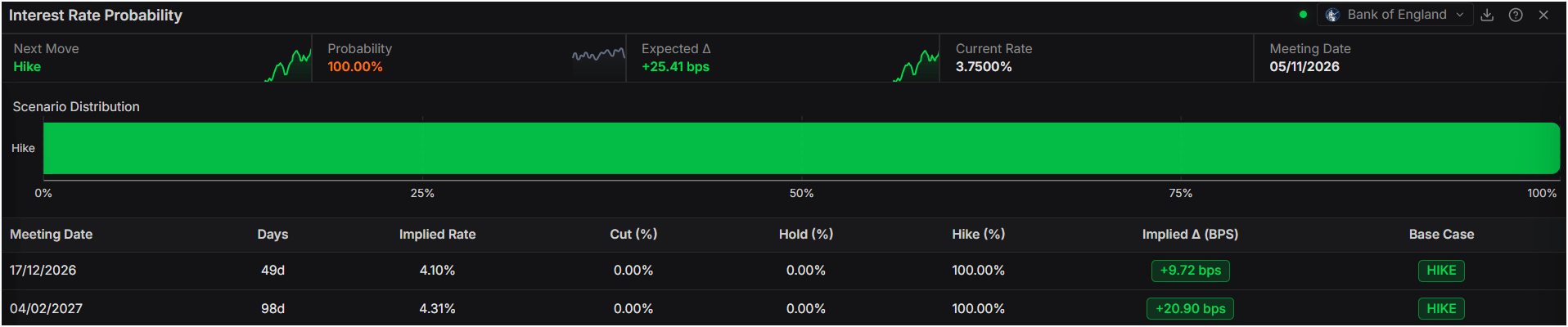
Beyond the immediate fiscal announcements, the primary focus for GBP/USD traders remained firmly fixed on the upcoming Bank of England (BoE) policy meeting scheduled for the following week. The market has already priced in a high probability of a 25-basis-point rate hike in November, with further expectations for another similar increase in February. Data from Prime Terminal, a widely used financial information platform, indicated these probabilities, reflecting market consensus that the BoE will continue its aggressive stance against inflation.
The Bank of England has been grappling with persistently high inflation, which has significantly eroded household purchasing power. The central bank’s Monetary Policy Committee (MPC) has consistently signaled its commitment to bringing inflation back to its 2% target, even if it means slowing economic growth. The anticipated rate hike next week would represent a continuation of this tightening cycle, aiming to cool demand and temper price pressures. The relative certainty of BoE action, contrasted with the recent pause by the Fed, could be a crucial factor in explaining the Pound’s strength against the Dollar, as market participants might be pre-emptively pricing in a more immediate and decisive tightening from the BoE.
The GBP/USD Paradox: Unpacking the Cross-Currents
The appreciation of the Pound Sterling against a robust US Dollar presents a fascinating paradox, given that strong US economic data typically strengthens the greenback. Several factors likely contributed to this seemingly counterintuitive market movement:
-
Relative Monetary Policy Expectations: While US data was strong, the Federal Reserve had just concluded a meeting where it held rates steady. The new information, while hawkish, points to a hike in December. In contrast, the Bank of England is widely expected to deliver a rate hike next week. This immediacy of anticipated BoE action, coupled with the ongoing inflationary pressures in the UK, could have led traders to price in a more aggressive short-term tightening path for the BoE relative to the Fed, at least for the immediate horizon. The market might be interpreting the BoE as having less flexibility to pause given the UK’s inflation situation.
-
Dollar Profit-Taking and Position Adjustments: The US Dollar has enjoyed a prolonged period of strength, driven by aggressive Fed tightening and its safe-haven appeal amidst global uncertainties. It is plausible that some traders engaged in profit-taking on long Dollar positions following the strong US data, especially if those positions were already heavily weighted based on previous expectations. This could lead to a temporary pullback in the Dollar, allowing other currencies like the Pound to gain ground.
-
UK Specific Factors: The UK budget, while introducing new taxes, also signaled an intent to address high energy prices. While the overall fiscal picture remains challenging, such measures could be perceived as supportive of economic stability in the near term, potentially providing some underlying support for the Pound. Furthermore, the firm commitment expected from the BoE, possibly reinforced by the government’s fiscal measures, might create a more compelling case for GBP appreciation in the short term.
-
Technical Rebound: The technical analysis provided indicates that the GBP/USD pair had reclaimed some ground from recent lows. The Relative Strength Index (RSI) at 54.4 hinted at improving momentum. While the broader structure suggested a capped recovery rather than a clear bullish trend, the ability to hold above certain support levels and the psychological boost from improving momentum could have triggered short-term buying, temporarily overriding fundamental divergences.
GBP/USD Price Forecast: A Technical Outlook
From a technical perspective, the GBP/USD currency pair is navigating a complex landscape. Currently trading around 1.3368, the pair exhibits a mildly bearish undertone on the daily chart. This sentiment is reinforced by its position beneath a cluster of simple moving averages (SMAs) hovering around 1.3385, which act as dynamic resistance levels. Furthermore, a descending trend-line resistance at 1.3393 further caps upside potential, indicating that sellers remain active at these higher price points.
Despite this prevailing bearish bias, the pair has demonstrated a capacity to reclaim some territory from its recent lows, suggesting underlying demand at lower levels. The Relative Strength Index (RSI 14), a momentum oscillator, currently stands at 54.4. A reading above 50 typically indicates improving momentum, supporting the idea that the recent bounce has some internal strength. However, it is crucial to note that the broader market structure for GBP/USD still shows the price trading below former rising support lines, which have now transitioned into resistance zones near 1.3652 and 1.3830. This configuration reinforces the notion that the current recovery is likely a corrective pullback within a larger downtrend, rather than the initiation of a sustained bullish trend.
Looking ahead, traders will be monitoring key resistance levels for potential breakouts or reversals. Initial resistance is identified at the aforementioned simple moving average cluster around 1.3385. A break above this level would then bring the descending trend-line barrier at 1.3393 into focus. A sustained and decisive breach above both these resistance points would be a significant technical development, potentially opening the path for a more substantial recovery. Such a move could see the pair target the former upward-sloping supports, now acting as formidable resistance, near 1.3652 and subsequently 1.3830.
Conversely, should the upward momentum falter, key support levels will come into play. The nearest notable underlying demand is anticipated around the prior downward resistance trend-line break, now serving as a support level, at approximately 1.3253. This level could attract buyers, potentially slowing any corrective pullback and offering a point of stabilization for the pair. A break below this level, however, would signal a resumption of bearish pressure and could lead to further declines. The interplay between fundamental drivers—like central bank policy and economic data—and these critical technical levels will dictate the GBP/USD’s trajectory in the coming days and weeks.
Broader Market Implications and Future Outlook
The complex dynamics observed in the GBP/USD pair underscore the intricate relationship between global economic data, central bank policies, and market sentiment. The divergence between strong US economic performance and the Dollar’s temporary weakness against the Pound highlights the importance of relative policy expectations and the timing of central bank actions.
For the global economy, the continued strength of the US economy is a double-edged sword. While it provides a locomotive for global growth, it also ensures that the Federal Reserve will remain vigilant in its fight against inflation, potentially leading to higher interest rates for longer. This, in turn, can create headwinds for emerging markets and increase the cost of borrowing globally.
In the UK, the balancing act between fiscal responsibility and mitigating cost-of-living pressures will be critical. The success of the budget measures and the Bank of England’s ability to tame inflation without triggering a deep recession will be paramount for the Pound’s longer-term trajectory.
As both the Federal Reserve and the Bank of England continue to navigate their respective battles against inflation, currency markets are likely to remain volatile. Traders will be keenly watching upcoming economic data releases, central bank communications, and geopolitical developments for further clues on the direction of major currency pairs like GBP/USD. The current scenario suggests that while fundamentals often guide long-term trends, short-term movements can be significantly influenced by shifts in relative expectations and technical factors.
