

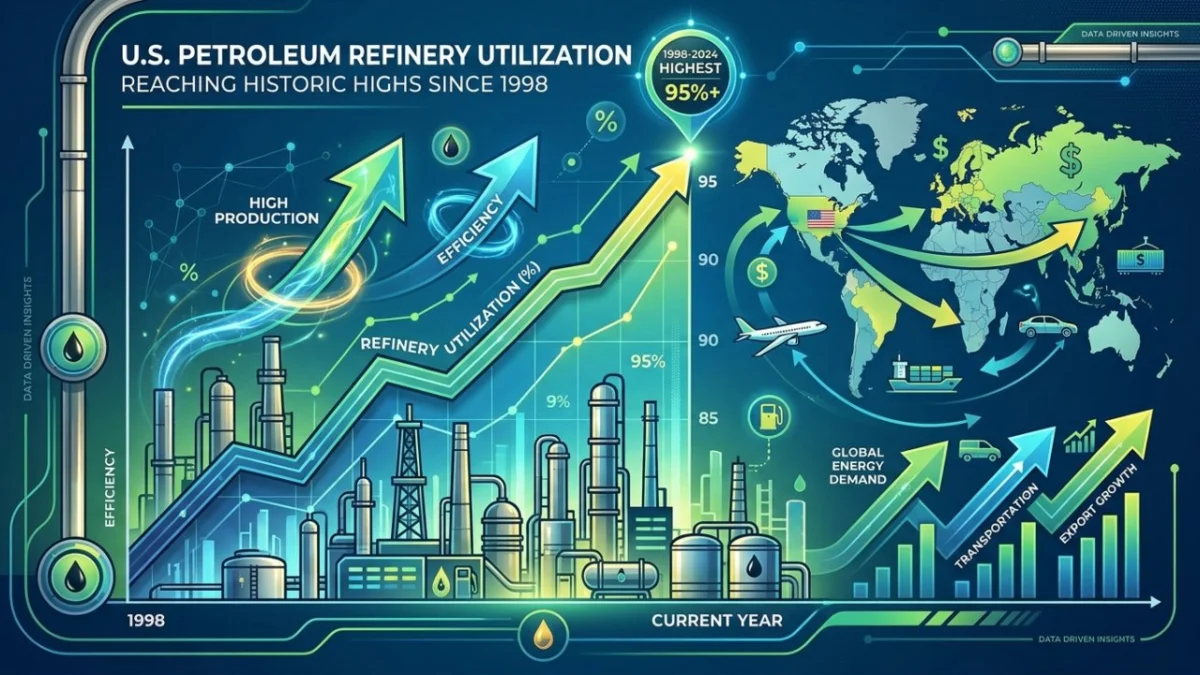
The United States refining sector has reached a historic operational milestone this year, recording an average utilization rate of over 95% between the months of May and September. This figure represents the highest level of activity for this specific seasonal window since 1998, highlighting a period of intense industrial exertion aimed at meeting a complex web of domestic and international energy requirements. While the American refining infrastructure has long been a cornerstone of the global energy market, the current surge in activity is driven by a unique confluence of tight global supplies, shifting geopolitical alliances, and a significant contraction in total refining capacity that has occurred over the last five years.
For industry analysts and small business owners alike, this record-breaking utilization rate is more than just a statistical anomaly; it is a signal of a structural shift in how petroleum products are produced and distributed. The data, primarily sourced from the U.S. Energy Information Administration (EIA), indicates that while the refineries are working harder than they have in decades, the net output is grappling with a diminished total capacity. This tension between high demand and constrained infrastructure is reshaping the economic landscape for sectors ranging from logistics and transportation to agriculture and manufacturing.
The Mechanics of High Utilization and Capacity Constraints
To understand the significance of a 95% utilization rate, one must first look at the traditional operational cycles of the American refining industry. Historically, U.S. refineries operate on a seasonal curve. During the summer months, often referred to as the "driving season," utilization typically climbs to approximately 92% as facilities ramp up production to meet the peak demand for gasoline. During the shoulder seasons—spring and autumn—utilization usually dips as refineries undergo scheduled maintenance, known in the industry as "turnarounds."
However, the current year has defied these historical averages. The push to maintain levels above 95% for five consecutive months suggests that refineries are deferring non-essential maintenance or operating at near-maximum thermal and mechanical limits to capture high profit margins. These margins, or "crack spreads," have been bolstered by a global shortage of refined products, particularly middle distillates like diesel and jet fuel.
Crucially, the record utilization rate does not equate to record total production. Since 2019, the United States has seen a net loss of approximately 4% of its total refining capacity. This reduction is the result of several high-profile refinery closures and conversions. Factors contributing to this decline include the permanent shutdown of the Philadelphia Energy Solutions (PES) complex following a massive explosion, the closure of several smaller facilities during the COVID-19 pandemic when demand cratered, and the strategic pivot of some plants toward renewable diesel production. Consequently, while the remaining refineries are running at 95% capacity, the total volume of fuel being produced is only at its highest level since 2019, rather than surpassing all-time historical peaks.
A Chronology of the Refining Landscape (2019–2026)
The journey to the current state of high utilization began with the unprecedented disruption of the 2020 global pandemic. In early 2020, as lockdowns halted travel, U.S. refinery utilization plummeted to nearly 67%, the lowest level in decades. This period of suppressed demand forced many aging or less efficient facilities into early retirement. By 2021, as the economy began to reopen, the industry faced a "supply shock" where demand recovered much faster than the capacity to refine crude oil into usable products.
In 2022, the geopolitical landscape shifted dramatically following the invasion of Ukraine. Sanctions on Russian petroleum products removed a significant portion of global diesel supply from the market, particularly impacting Europe. The U.S. refining sector stepped in to fill this vacuum, transitioning from a primarily domestic provider to a critical "swing producer" for the international market. This shift solidified the high-utilization trend that has persisted into the current year.

By 2024 and 2025, the industry reached a state of precarious equilibrium. The lack of investment in new, large-scale "greenfield" refineries—due to regulatory pressures and the long-term transition toward electric vehicles—meant that the existing fleet had to work harder to keep up with both domestic recovery and foreign export demand. This brings the timeline to the current 2026 milestone, where the system is operating at its mechanical ceiling to sustain global energy security.
The Pivot to Distillates: Diesel as the Global Currency
While gasoline often dominates the headlines due to its direct impact on consumer sentiment at the pump, the current refinery surge is fundamentally driven by distillate fuel oils. Diesel is the lifeblood of the global industrial economy, powering freight ships, long-haul trucks, trains, and heavy machinery.
Jimmy Troderman, a Principal contributor for the U.S. Energy Information Administration, noted that high international demand for U.S. distillate fuel oil exports has been the primary engine keeping refinery outputs elevated. For much of the year, European and Asian markets have looked to the U.S. Gulf Coast to supplement their inventories. This international pull has kept domestic diesel prices relatively firm, even during periods when crude oil prices fluctuated.
For small businesses, this focus on distillates is a double-edged sword. On one hand, the high utilization ensures that there is a steady flow of product, preventing the kind of acute shortages that can paralyze supply chains. On the other hand, because the U.S. is now a primary exporter, domestic businesses must compete with international buyers for the same gallon of fuel. This global competition keeps a "floor" under prices, preventing the significant cost relief that small business owners in the transportation and construction sectors often hope for during the off-peak season.
Implications for Small Business Operations
The ripple effects of 95% refinery utilization are felt most acutely by small and medium-sized enterprises (SMEs). Unlike large corporations that may have the leverage to negotiate long-term fixed-price fuel contracts or the capital to hedge against price volatility, small businesses often operate on "spot" prices, making them vulnerable to daily market shifts.
Logistics and Transportation
Small trucking firms and independent owner-operators are directly impacted by the availability and price of diesel. With refineries running at maximum capacity to meet export demand, any unplanned outage—such as a fire or a mechanical failure at a major refinery—could lead to localized price spikes. Business owners are being advised to maintain flexible routing and to consider fuel surcharges in their client contracts to protect their margins.
Agriculture and Construction
In the agricultural sector, diesel is essential for harvesting and transporting crops. The current high utilization rate coincided with the peak harvest season, providing a necessary buffer against supply disruptions. However, the 4% decrease in total refining capacity means that the system has very little "spare" capacity. If a major hurricane were to hit the Gulf Coast refining hub, the lack of a production cushion could lead to immediate regional shortages for farmers and builders.
Strategic Planning and Forecasting
Market analysts suggest that small business leaders should utilize more sophisticated forecasting tools. Understanding that refinery utilization typically dips in October and November for maintenance is crucial. During these windows, inventory levels may tighten, potentially leading to price increases before the winter heating oil season begins. By monitoring these cycles, businesses can engage in strategic purchasing, filling on-site storage tanks when utilization is high and prices are relatively stable, rather than waiting for seasonal peaks.

Official Responses and Market Analysis
The reaction from government bodies and industry trade groups has been one of cautious optimism tempered by warnings about infrastructure aging. The EIA has emphasized that while the current performance is impressive, the "strain on the system" is visible. Operating at 95% for extended periods increases the risk of mechanical fatigue, which could lead to a higher frequency of unplanned shutdowns in the future.
Industry advocates, such as the American Fuel & Petrochemical Manufacturers (AFPM), have pointed to these utilization rates as evidence of the industry’s resilience. However, they also use these figures to argue for policies that encourage investment in refining infrastructure. They contend that without the ability to expand capacity or streamline the permitting process for upgrades, the U.S. will continue to face a "capacity ceiling" that leaves the economy vulnerable to global shocks.
From a macroeconomic perspective, the high refinery activity has been a boon for the U.S. balance of trade. By exporting high-value refined products like diesel and jet fuel, the U.S. has strengthened its position as a global energy powerhouse. However, economists warn that this comes at the cost of higher domestic energy inflation, as American consumers and small businesses are essentially paying "world prices" for fuel produced in their own backyard.
Looking Ahead: The Future of U.S. Refining
As the market moves toward the end of the year, the slight dip in utilization rates observed in October is a natural part of the industrial cycle. However, the fact that these rates remain above the five-year seasonal average suggests that the period of "tightness" is far from over.
The long-term outlook for U.S. refineries involves a delicate balancing act. On one side is the immediate, pressing demand for fossil fuels to power a post-pandemic global economy. On the other is the accelerating energy transition. Many refining companies are hesitant to invest billions in new capacity that may take a decade to build, fearing that by the time the plants are operational, demand for gasoline may be in a permanent decline due to the rise of electric vehicles.
This hesitation means that the current fleet of refineries will likely continue to operate at near-maximum utilization for the foreseeable future. For the small business owner, the "new normal" is a market characterized by high efficiency but zero margin for error. Success in this environment requires a deep understanding of energy trends, a proactive approach to fuel management, and the agility to adapt to a global market where a refinery’s output in Texas is just as likely to end up in a truck in Hamburg as it is in a delivery van in Chicago.
In summary, the 95% utilization milestone is a testament to the technical prowess of the U.S. energy sector, but it also serves as a reminder of the limits of current infrastructure. As refineries continue to run at breakneck speeds to satisfy a thirsty global market, the intelligence and preparedness of small business leaders will be the deciding factor in navigating the opportunities and challenges of this high-pressure energy landscape.
