

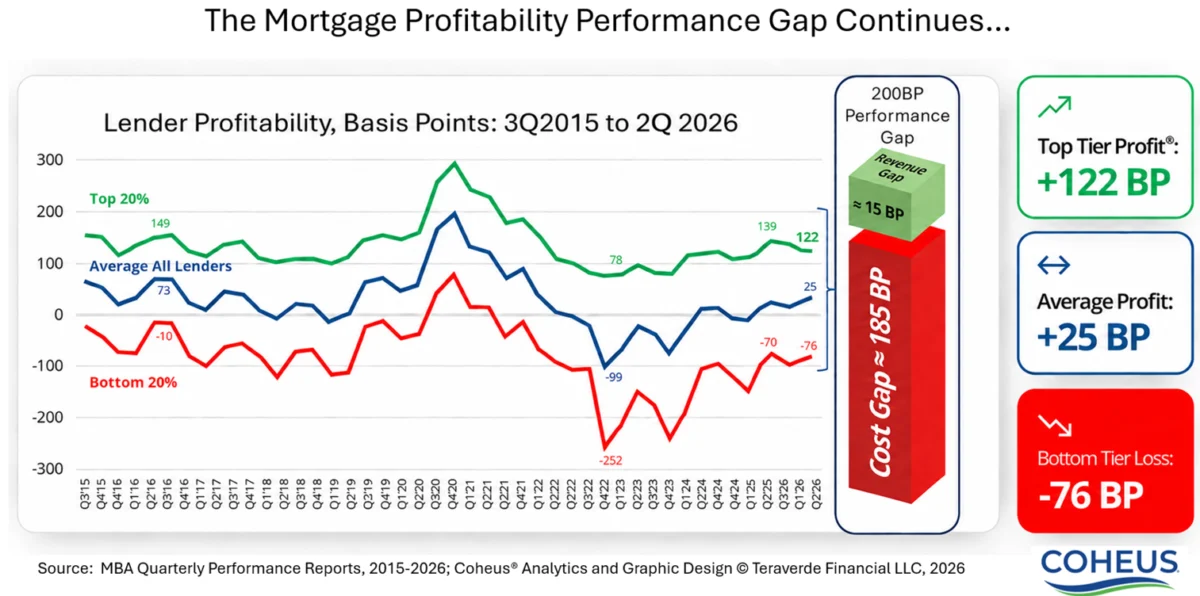
The mortgage banking industry stands at a critical juncture as executive sentiment shifts from cautious optimism to a sober recognition of long-term structural challenges. Recent industry gatherings, including the HousingWire Mortgage Banking Summit on October 1 and the Mortgage Bankers Association (MBA) Annual Convention, have highlighted a stark divergence between the promise of technological revolution and the reality of stubborn operational inefficiencies. While the exhibit halls of these conferences are currently saturated with vendors promoting Artificial Intelligence (AI) and automated solutions, the underlying financial data suggests that technology alone has failed to bridge a widening performance gap that separates top-tier lenders from the rest of the market.
At the HousingWire summit, a live survey of industry executives revealed a grim consensus: 70% of participants expect mortgage rates to remain at 7.5% or higher for at least the next six months. This sentiment was echoed and amplified two weeks later by MBA Chief Economist Mike Fratantoni, who delivered a sobering forecast for the next 24 months. The MBA outlook predicts flat production volumes and offers little hope for significant rate relief in the near term. For mortgage executives, the message is clear: the era of being rescued by a sudden refinancing wave is over, and the path to profitability must be paved through internal operational excellence rather than external market shifts.
The 200 Basis Point Performance Gap and the Limits of Technology
Despite decades of investment in digital transformation, the cost to originate a mortgage remains historically high. Industry data from the second quarter of 2026 indicates that a "200 Basis Point Performance Gap" persists among lenders. This gap is not merely a statistical anomaly; it translates into a difference of over $7,000 in net production income per loan between high-performing and low-performing organizations. While technology vendors have long promised that automation would drive origination costs toward zero, the reality is that many lenders are still struggling with revenue leakage, price exceptions, and redundant manual processes.
The persistent nature of this gap suggests that the industry does not suffer from a shortage of technology, but rather a shortage of measurable results and accountability. Historically, technology investments in the mortgage space have been evaluated based on vendor promises and theoretical Return on Investment (ROI) models. However, the current economic climate demands a shift toward measuring the economics of the entire business process. This requires identifying exactly what generates cash and what consumes it at every level—from specific loan products and pricing strategies to the productivity of individual employees.
A Chronology of Market Shifts: From Refinance Boom to Structural Stagnation
To understand the current urgency for "strategic triage," one must look at the timeline of the mortgage market’s evolution over the last several years. Following the 2008 financial crisis, the industry underwent a massive regulatory overhaul, which significantly increased the compliance burden and the cost of labor. The subsequent period of historically low interest rates, peaking during the 2020-2021 refinance boom, allowed many lenders to mask operational inefficiencies with record-high volumes.
The landscape shifted abruptly in 2022 and 2023 as the Federal Reserve aggressivey raised interest rates to combat inflation. This transition effectively ended the refinance era, leaving a massive inventory of existing mortgages with rates below 6%. This "lock-in effect" has severely limited housing turnover and eliminated the possibility of another refinancing wave comparable to those that saved the industry in previous downturns. By late 2025 and moving into 2026, the industry reached a state of "crucible" pressure, where the cost structures built for high-volume environments became unsustainable in a low-volume, high-rate market.
The Mechanics of Strategic Triage: Prioritizing Cash Flow
When financial performance begins to deteriorate, the traditional executive response is often indiscriminate cost-cutting. However, industry experts Jim Deitch and Rick Roque argue that such a "chainsaw" approach can often damage the core capabilities that generate positive cash flow. Instead, they advocate for a process of "triage"—a disciplined assessment designed to maximize financial runway and create the stability necessary for long-term strategic decisions.
The triage process begins with a granular understanding of the organization’s economics. Executives must ask: Which branches and producers are creating genuine economic value? Which processes are consuming unnecessary cash? Where are pricing decisions eroding margins? In many cases, company-wide averages for "cost-to-originate" conceal massive variations. A lender might report acceptable overall performance while several individual branches or product lines are actively depleting the firm’s capital reserves. The objective of triage is to stop these cash-draining activities immediately, thereby strengthening the organization’s liquidity position.

Addressing Revenue Leakage and Accountability
One of the most immediate opportunities for financial improvement identified by market analysts is the elimination of revenue leakage. Revenue leakage includes avoidable costs such as pricing concessions, lock extensions, disclosure cures, uncollected fees, and preventable loan fallout. For a lender originating $1 billion annually, even a modest 25 basis points of avoidable leakage represents $2.5 million in lost revenue.
Recovering even half of that leakage can improve a lender’s bottom line by $1.25 million without the need to increase production volume. However, achieving this requires a culture of accountability that has been lacking in many mortgage operations. Accountability in this context does not mean a culture of blame; rather, it involves giving employees visibility into the financial consequences of their decisions. When loan officers and processors understand how specific delays or concessions impact the firm’s viability, and are given the tools to improve, the results are typically reflected in the margin.
Matching Capacity to Realistic Production Expectations
A major hurdle for many lenders is the psychological difficulty of adjusting operating capacity. Historically, the mortgage industry has been prone to "staffing for hope"—maintaining high overhead and large headcounts in anticipation of a market turn that would bring back high volumes. In the current environment, this strategy is increasingly viewed as a liability.
The new mandate for C-suite executives is to align processing, underwriting, closing, and corporate infrastructure with realistic, data-driven production expectations. This involves a delicate balance: preserving high-performing assets (skilled employees with deep mortgage knowledge) while eliminating the "dead weight" of unnecessary expense. Productivity must be measured through funded units, turn times, and direct labor costs. If capacity materially exceeds demand, management must act decisively, as maintaining excess infrastructure is no longer a strategic reserve but a continuous drain on cash.
Two Strategic Paths: Transformation vs. Combination
Once a business has been stabilized through triage and its cash flow is protected, two primary strategic options emerge for the future.
The first option is a total transformation of the operating model. This path is available to lenders with sufficient capital and a strong management team. It involves the integration of "agentic AI"—AI systems capable of making decisions and executing tasks rather than just generating text—to automate routine workflows, reduce defects, and exponentially increase employee productivity. However, this is not an IT project; it is an operating strategy. Every technological initiative must be tied to a specific financial target and a strict implementation timetable.
The second option is to pursue a strategic combination or merger. In a market where scale and efficiency are the primary drivers of survival, joining forces with a partner that offers complementary strengths in manufacturing, capital, or distribution can be a highly effective move. Experts emphasize that timing is the most critical factor in M&A. A company that has already undergone triage and boasts positive cash flow and disciplined operations has significantly more negotiating leverage than a company facing a liquidity crisis.
The Role of the C-Suite: Ownership of Financial Outcomes
The current market cycle serves as a reminder that while consultants can provide analysis and technology can provide insights, the ultimate responsibility for financial outcomes rests with the CEO and the leadership team. Strategic decisions regarding pricing discipline, capital allocation, and operational capacity cannot be delegated to middle management or outsourced to technology vendors.
The "Into the Crucible" series, which concludes with these findings, underscores that waiting for lower interest rates is a forecast, not a strategy. The mortgage companies that survive the next decade will be those that embrace accountability, demand measurable results from their technology, and have the courage to restructure their organizations for the reality of the market rather than the hope of its return. As the industry moves further into 2026, the window for action is closing, and the distinction between the "haves" and the "have-nots" of the mortgage world will be defined by their willingness to act now.
