

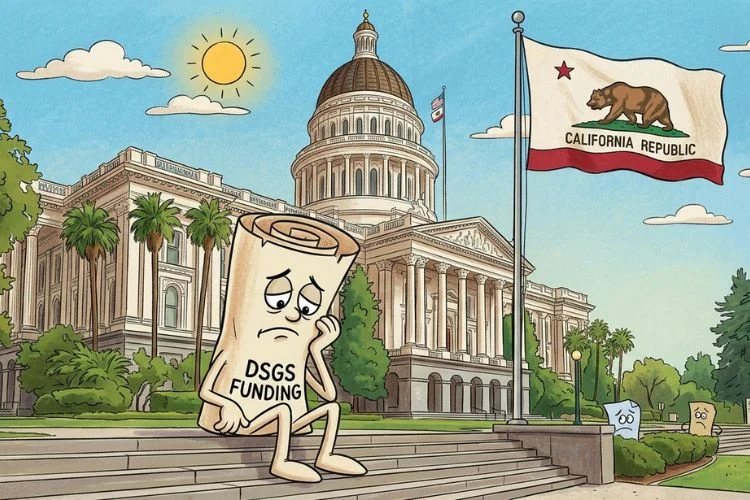
The most robust virtual power plant (VPP) program in the United States, California’s Demand Side Grid Support (DSGS) initiative, is approaching a financial precipice at the exact moment the state’s electrical infrastructure requires its services most. Since its inception in 2022, the DSGS program has grown to coordinate more than 1 gigawatt (GW) of dispatchable capacity, drawing from over 200,000 unique customer sites across every legislative district in California. By leveraging distributed energy resources (DERs) such as residential battery storage, solar photovoltaic systems, and smart thermostats, the program has become a cornerstone of the state’s strategy to maintain grid reliability during extreme weather events. However, despite its proven efficacy in preventing blackouts and stabilizing energy prices, the program faces an uncertain future as legislative funding expires and the state grapples with a transition toward a more permanent market structure for flexible demand.
The Evolution of California’s Demand Side Grid Support Program
The DSGS program was born out of necessity following the California energy crisis of August 2020, when a historic heatwave led to rolling blackouts for hundreds of thousands of residents. In response, Governor Gavin Newsom issued an emergency proclamation in 2021, which eventually led to the creation of the DSGS by the California Energy Commission (CEC). The program was designed to incentivize large-scale participation in grid stabilization by offering payments to customers and aggregators who could reduce their electricity draw or export power to the grid when the California Independent System Operator (CAISO) faced supply shortages.
Unlike traditional demand-response programs, which often rely on manual curtailment by industrial users, the DSGS leverages the "Virtual Power Plant" model. This approach aggregates thousands of small-scale resources into a single, cohesive block of power that grid operators can call upon with the same reliability as a traditional natural gas peaker plant. From its launch through 2024, the program has scaled rapidly. It currently manages a capacity roughly equivalent to two large gas-fired power plants, all while producing zero on-site emissions and utilizing existing consumer investments in clean technology.
The program’s impact on grid management has been quantifiable. Since the DSGS became fully operational, CAISO has managed to avoid the involuntary load shedding that characterized previous years. Notably, the state has not issued a single Flex Alert—the public call for voluntary energy conservation—in over four years, a streak that energy analysts attribute in large part to the "invisible" support provided by automated VPP dispatches.
Record-Breaking Performance During the 2026 Heatwaves
The true test of the DSGS program’s maturity occurred in late 2026. On September 9, 2026, California recorded its highest electricity demand in four years. While such a peak would have historically triggered emergency measures or rolling outages, the grid remained stable. This stability was bolstered by the addition of 39,000 megawatts (MW) of new clean energy since 2019, including a massive 23,000 MW of utility-scale and distributed battery storage.
The following month, during a prolonged heatwave on October 5 and 6, the DSGS program reached new milestones. Leading aggregators Sunrun and Tesla delivered back-to-back record-breaking dispatches. On October 5, the combined fleet dispatched 669 MW of power to the grid; on October 6, that figure climbed to 745 MW. To put these numbers in perspective, Brandon García, California Director for Advanced Energy United, noted that approximately 500 MW is sufficient to power the entire city of San Francisco. The ability to run major metropolitan areas on residential batteries alone represents a paradigm shift in utility management.
These dispatches were triggered by the program’s "affordability mechanism," which activates when wholesale market prices reach $200 per megawatt-hour. By flooding the market with distributed power during these price spikes, the DSGS effectively drove prices back down, protecting all California ratepayers from the high costs of peak energy procurement. Lauren Nevitt, Senior Director of California Policy and Energy Markets at Sunrun, emphasized that the program has evolved from a mere emergency backup into a sophisticated tool for maintaining statewide energy affordability.
The Funding Gap and Legislative Uncertainty
Despite these successes, the DSGS program is currently operating on borrowed time. In June 2026, the California Legislature allocated a stop-gap fund of $27 million to maintain operations through the end of the calendar year. However, the intensity of the 2026 summer heatwaves and the resulting high frequency of program dispatches have likely depleted these funds faster than anticipated.
The program was never designed to be a permanent fixture of the state budget; rather, it was envisioned as a bridge to a more sustainable, market-based solution. However, the most recent legislative session concluded without a clear pathway for 2027 and beyond. This lack of a durable funding mechanism creates a "cliff" for participants and aggregators. If the program cannot guarantee performance payments, the 200,000 participants currently enrolled may see their incentives vanish, potentially leading to a mass exodus from the program and a significant loss of grid-stabilizing capacity.
Industry experts argue that the lack of funding is a paradox of the program’s success. "If there was no need for the program, then we would have the full $27 million," García remarked. "But it got used; people needed it." The depletion of the coffers serves as empirical evidence of the program’s necessity, yet it simultaneously threatens its survival.
The Economic Case: The Brattle Group Findings
As policymakers debate the future of the DSGS, a new report from The Brattle Group, titled The Affordability Advantage: How Virtual Power Plants Can Alleviate Household Electricity Bill Pressure, has provided significant data to support the expansion of VPPs. The report suggests that rapidly scaling residential VPPs could mitigate expected household electricity bill increases by more than 50% over the next five years.
The economic logic is centered on "avoided costs." By using VPPs to shave peak demand, utilities can avoid multi-billion-dollar investments in new transmission lines and traditional power plants that are only needed a few hours per year. According to the report, the total value created by a VPP is over seven times the cost of enabling it. The majority of this value is returned to consumers in the form of performance payments, creating a virtuous cycle where residents are incentivized to invest in clean energy technology that, in turn, lowers the cost of the grid for everyone.
Nevitt argues that this data should shift the conversation from "funding a program" to "investing in an infrastructure asset." The DSGS proves that consumers can act as drivers of innovation, providing dependable capacity that utilities can rely on with the same confidence as a physical power station.
Legislative Milestones and the Path Forward
While the funding for DSGS remains in limbo, the broader legislative environment in California has seen several successes. Advanced Energy United has pointed to several bills that aim to redefine the state’s energy future:
- SB 913: Focused on streamlining the integration of DERs into the larger grid framework.
- SB 868 and SB 905: Legislation aimed at increasing transparency in utility planning and promoting the adoption of long-duration energy storage.
These bills reflect a growing recognition among lawmakers that the centralized grid model of the 20th century is no longer sufficient. However, the transition to a decentralized "grid of the future" requires more than just policy goals; it requires a stable market where VPPs can compete on a level playing field with traditional generators.
Stakeholders are now looking toward the next gubernatorial administration and the 2027 legislative session for a permanent solution. One proposed pathway is "early budget action," a mechanism California has used previously to address urgent infrastructure needs. Alternatively, there is a push to move VPPs out of the realm of state-funded "programs" and into the CAISO wholesale market as a permanent resource class. Nevitt suggests that if DSGS is allowed to expire, it must be replaced immediately by a more robust market vehicle that recognizes the full value of distributed resources.
Implications for the National Energy Landscape
The situation in California serves as a bellwether for the rest of the United States. As states like Texas, New York, and Massachusetts explore their own VPP frameworks, the challenges facing the DSGS program highlight the difficulties of moving from pilot projects to permanent utility structures.
If California—the nation’s leader in clean energy adoption—cannot establish a durable pathway for its most successful VPP program, it may signal trouble for the broader national transition to a decentralized grid. Conversely, a successful resolution that secures long-term funding or market integration for the DSGS could provide a blueprint for other states to follow.
The convergence of rising electricity demand (driven by data centers and the electrification of transport), extreme weather, and the need for affordability makes the DSGS more than just a local policy issue. It is a critical component of energy security. As García noted, the current situation is "untenable" without change, but the success of the DSGS provides a clear, data-backed reason for optimism. The technology has proven it can save the grid; the remaining question is whether the political and financial structures of the state will evolve fast enough to let it continue doing so.
