

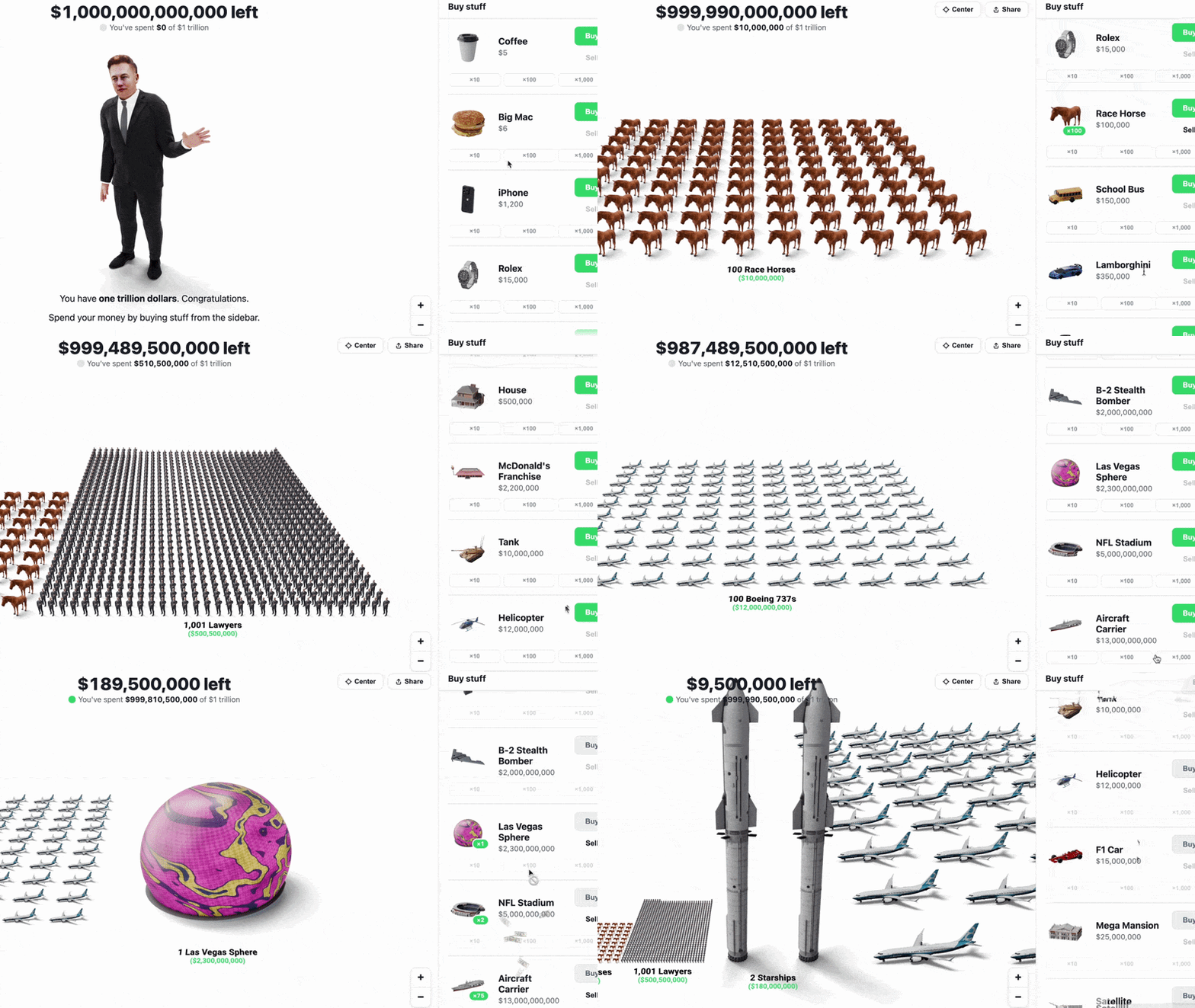
Elon Musk, the enigmatic figure at the helm of transformative companies like Tesla and SpaceX, frequently finds his net worth hovering around the staggering sum of one trillion dollars. This immense valuation, however, is not a reflection of physical currency stashed in vaults. Instead, it is primarily tied to the stock performance of his ventures. Should Musk liquidate his holdings in SpaceX and Tesla, divest from Neuralink and The Boring Company, and consolidate all his liquid assets, his bank account would indeed feature a thirteen-digit figure, a testament to a financial scale that defies easy comprehension.
The word "trillionaire" itself, while simple to utter, presents a profound challenge to the human mind’s capacity to grasp its sheer magnitude. Research in neuroscience has consistently demonstrated our inherent difficulty in processing such astronomical numbers. A trillion can easily sound like a mere extension of a billion, a slight numerical step, when in reality, it represents a thousandfold increase. Even with abstract comparisons to familiar entities like Central Park’s area or the collective weight of heavy machinery, the true scale of a trillion dollars remains elusive and abstract. A more tangible approach to understanding this colossal sum is to explore what it could actually purchase, a concept now brought to life through an innovative online visualization.
Unveiling the Scale of a Trillion Dollars: The "Spend Elon Musk’s Money" Visualization
In partnership with Neal Agarwal, the creator of the widely acclaimed website Neal.fun, WIRED has launched an interactive tool designed to demystify the concept of a trillion-dollar fortune. Titled "Spend Elon Musk’s Money," this visualization allows users to virtually spend Musk’s estimated wealth on an eclectic array of items, ranging from the everyday Big Mac to monumental structures like the Las Vegas Sphere and even military hardware such as aircraft carriers. The platform meticulously tracks expenditures, offering a real-time glimpse into the astonishing purchasing power of a trillion dollars and visually representing the accumulated acquisitions in a simulated physical space.
This initiative stems from a desire to bridge the gap between abstract financial figures and relatable consumer choices. As Agarwal, the proprietor of Neal.fun, explained in a recent interview, the project aims to provide a more intuitive understanding of extreme wealth than traditional charts or graphs can offer. "Research has shown that the human brain has a very hard time comprehending the actual size and scope of large numbers," Agarwal stated. "Trillion sounds like a short hop from billion, after all, even though it is in fact 1,000 times bigger. And even if you are somehow able to wrap your mind around that immense scale, it still feels abstract, no matter how many times you compare it to the area of Central Park or the weight of a fleet of trucks."
The Genesis of Neal.fun: A Digital Playground for Exploration
Neal.fun has evolved into a unique digital repository of Agarwal’s diverse interests since its inception when he was just 19 years old. Described by Agarwal as "almost like a journal," the site serves as a catalog of visualizations, scientific explorations, and intriguing game mechanics. "I never wanted to constrain the site to one thing," he explained. "For me, it’s mostly an exploration of what you can do with a website."
Agarwal’s deep connection to the internet is a driving force behind his work. Having grown up immersed in online communities, he views the web as a dynamic and relatively nascent medium with vast unexplored potential. "I grew up on the web; I was 8 years old on forums. I probably spent more time in Club Penguin than any real-world walls," he reflected. "I’m definitely a child of the web, and it’s interesting that I’m around the same age as it. It’s a privilege. Painters are working in a medium that’s a thousand years older, a million years older, so a lot of things have already been found out, been fleshed out. But on the web there’s so much that we haven’t figured out yet. I think there’s still a lot of new stuff to discover, and that’s really interesting to me."
He emphasizes the distinct capabilities of different media. Just as a book cannot be perfectly replicated as a film, the web possesses unique characteristics that lend themselves to specific forms of expression. "I think every medium has distinct things you can do with it," Agarwal noted. "This visualization we’re working on, you can’t print it in a newspaper."
Viral Successes and Emergent Communities: The Power of Interactive Web Experiences
Several of Agarwal’s projects have achieved significant viral traction, capturing the attention of a global audience. Titles such as "The Password Game," "Space Elevator," "The Deep Sea," and "Infinite Craft" have become household names for many internet users. The phenomenon of a project resonating so strongly is a source of fascination for Agarwal, particularly when users begin to engage with his creations in unexpected ways.
"I think each project has been very different," he stated. "The ones that excite me the most now are where a lot of people play it and start doing things with it that I did not expect or intend. Within a few days of Infinite Craft launching, people started crafting Japanese words within the game. And they crafted enough Japanese words that they could play the whole game in Japanese. I’ve never released a game before where they unlocked a language."
Another example is "Internet Road Trip," a simulated journey through Google Street View. This project fostered the creation of a Discord community where participants engaged in "backseat driving," debating destinations and pit stops. This led to emergent behaviors like birdwatching within the virtual environment. Agarwal sees this as a testament to the web’s unique ability to foster communities around even the most whimsical of interests. "All these emergent things started happening, and I think the web is really good at that, too. It’s really good at forming communities out of the silliest things, which I find really exciting."
A Return to Visualization: The Evolution from Bill Gates to Elon Musk
The "Spend Elon Musk’s Money" visualization is a spiritual successor to Agarwal’s earlier project, "Spend Bill Gates’ Money," which was instrumental in the initial launch of Neal.fun. That original project aimed to illustrate the scale of $100 billion, a sum that now appears considerably more modest in comparison to Musk’s current estimated wealth.
"Spend Bill Gates’ Money" featured a straightforward premise: a $100 billion counter and a list of purchasable items with associated prices. Users could add items to their virtual cart, observing the diminishing balance. The inventory ranged from inexpensive goods like Big Macs and flip-flops to luxury items such as diamond rings, Ferraris, and even priceless art like the Mona Lisa. The response to this initial visualization was overwhelmingly positive, marking it as one of Agarwal’s most successful launches.
"It was one of the biggest things I’ve launched, and it was really nice to see that the point got across," Agarwal recalled. "People understood that this is a way to visualize wealth that isn’t just graphs and bar charts. The game kept finding a new audience over and over again; it was an idea that kept being interesting to people."

The Trillion-Dollar Leap: A New Dimension of Visualization
The emergence of a trillionaire in the modern economic landscape presented a compelling opportunity to revisit and expand upon the concept of wealth visualization. The "Spend Elon Musk’s Money" project embraces this new scale, employing a 3D interface to enhance the user’s sense of immersion and understanding.
"Yeah, I think so," Agarwal responded when asked if it felt like the right time to revisit the concept. "There’s a lot more you can do to visualize that, too. That’s why this one is 3D. I think one thing with Spend Bill Gates’ money is, yeah, you can buy 10,000 cars, but it’s still a number on a screen. With Spend Elon Musk’s Money, I want you to see the cars you’re buying on a screen. The amount of physical stuff you can buy—it is an empire."
The inherent difficulty in conceptualizing a trillion dollars is a central theme addressed by the visualization. The psychological barrier to understanding such vast numbers is significant, as noted by Agarwal, who referenced research indicating human brains struggle to process even incremental increases from billions to trillions. The web’s capacity for infinite scrolling and expansive digital environments offers a unique solution to this cognitive challenge.
"I think that’s one thing the web is actually really good at, is that you have infinite space," Agarwal observed. "You can visualize these numbers in ways that you can’t do in the physical world. Even for my project The Deep Sea, it’s a 1:1 of the ocean. If you wanted to print that out on paper, it would be a mile long, but on the web you can just keep scrolling and scrolling. So it’s kind of fun to have this infinite scroll mechanic to visualize these huge numbers."
Curating the Catalogue of Consumption: From Tractors to Spacecraft
The selection of items available for purchase within "Spend Elon Musk’s Money" was a deliberate process aimed at providing tangible and visually impactful examples of what a trillion dollars can acquire. While some items echo those from the Bill Gates visualization, the list has been expanded to reflect the increased scale and availability of high-value assets.
"This time I was going for more tangible things, so you can visualize it," Agarwal explained. "It’s honestly hard to think of items; once you get to $100 million, there are only so many things out on the market that you can buy. So we have the Las Vegas Sphere in there, and aircraft carriers."
The visualization also highlights the diminishing returns and potential futility of accumulating such immense wealth in material possessions. "After a point it’s kind of interesting that you’re like, OK, I could buy 1,000 more tanks, what would that really get me?" Agarwal mused. "Part of the fun of this one is just the futility of it. At a certain point, what more could a person need?"
For instance, a user might purchase 1,000 monster trucks and still have a substantial portion of the trillion dollars remaining, illustrating the vastness of the sum. Agarwal also considered alternative visualization methods, such as rendering a physical stack of a trillion dollars in bills, but found it technically challenging and less impactful. The decision to focus on purchasable items, rather than abstract concepts like corporate acquisitions or political influence, was driven by the goal of making the scale of wealth more relatable to the average user.
Technical Innovations and the Echoes of Inflation
The development of the "Spend Elon Musk’s Money" visualization presented its own set of technical hurdles. Agarwal initially aimed for all items to be rendered as 3D models, but the computational demands of rendering a million monster trucks, for example, proved too great for typical user devices, leading to potential freezing. This necessitated the implementation of clever graphical techniques to achieve a 3D aesthetic without relying on full 3D model rendering.
A subtle yet significant feature of the visualization is its implicit acknowledgment of economic realities, particularly inflation. By comparing the prices of common items to those in the original "Spend Bill Gates’ Money" project, the updated visualization starkly illustrates price increases over time. For example, a Big Mac, priced at $2 in the earlier iteration, now costs $6.
"It’s very inflation-adjusted," Agarwal confirmed. "Which is crazy, because it’s only been six or seven years. If anyone has any recommendations about other items we should add to this, just let me know." This attention to detail not only adds realism to the simulation but also serves as a subtle commentary on the changing cost of goods and services in the modern economy.
Broader Implications: The Web as a Tool for Understanding Complex Realities
The "Spend Elon Musk’s Money" project transcends a mere entertainment tool. It functions as an educational instrument, leveraging the interactive and visual capabilities of the web to demystify concepts that are otherwise abstract and overwhelming. In an era where discussions about wealth inequality, extreme fortunes, and the economic impact of visionary entrepreneurs are commonplace, such visualizations become invaluable for fostering public understanding and informed discourse.
The success of Neal.fun and its collaboration with WIRED underscores the internet’s enduring potential as a platform for innovation, education, and community building. By translating complex financial data into engaging and interactive experiences, Agarwal is not only exploring the boundaries of web development but also providing the public with novel ways to grapple with the monumental forces shaping our world. As the digital landscape continues to evolve, projects like "Spend Elon Musk’s Money" demonstrate that the web can serve as a powerful conduit for understanding even the most unfathomable aspects of modern society.
