

The Swiss glacier network, which holds the largest volume of glacial ice in the European Alps, experienced a catastrophic loss of 5.5% of its total ice volume over the past twelve months, marking the second-largest percentage decline since record-keeping began. According to a joint report released Thursday by the GLAMOS Swiss glacier monitoring service and the Swiss Academy of Sciences, the rapid deterioration of these ancient ice masses has reached a critical threshold, with experts warning that Alpine glaciers are unlikely to survive the long term if current atmospheric conditions persist. This latest data underscores a harrowing trend: in just the last five years, Switzerland has seen nearly 20% of its total glacial ice disappear, a rate of melting that was once thought impossible by glaciologists within such a short timeframe.
The report serves as a stark testament to the intensifying effects of anthropogenic climate change on Europe, which has been identified as the world’s fastest-warming continent. Matthias Huss, a prominent glaciologist at the Swiss Federal Institute of Technology (ETH Zurich) and the head of GLAMOS, emphasized that the current rate of warming is inextricably linked to human activity. Huss noted that the warming experienced in the modern era can be attributed entirely to human-induced emissions and the continued reliance on fossil fuels, stating clearly that without these external forcing factors, the current level of glacial retreat would not be occurring.
Mechanisms of Decay: Heat Waves and Snow Scarcity
The 5.5% loss recorded this year follows a pattern of "extreme melting" that has been exacerbated by two primary meteorological factors: insufficient winter snowfall and intense summer heat waves. While 2022 remains the record-holder for absolute ice loss—partially due to a rare influx of Saharan dust that darkened glacier surfaces and increased solar absorption—the current year’s percentage drop is particularly alarming because the total volume of ice remaining is significantly smaller than in previous decades.
Snow cover plays a dual role in the health of a glacier. First, it acts as a protective "insulation" layer. A thick blanket of winter snow reflects solar radiation and shields the underlying "old ice" from the sun’s rays during the spring and early summer. The longer this snowpack remains, the later the melting of the actual glacier body begins. Second, snow serves as the primary "nourishment" for a glacier. At high elevations, snow that survives the summer eventually compacts into firn and, over years, transforms into new glacial ice. When winter snowfall is low, as has been the case in recent Swiss winters, the glaciers lose both their protective shield and their ability to regenerate, leading to a net deficit that is impossible to recover during cooler cycles.
A Comparative Analysis of Historical Melting
To understand the gravity of the current situation, scientists often compare recent data to the heatwave of 2003, which was previously considered a once-in-a-century event. In 2003, the absolute volume of ice lost was higher than in the current year; however, the relative percentage loss was lower, at approximately 3.5%. This discrepancy is due to the fact that the total volume of Swiss glaciers today is only about one-third of what it was twenty-three years ago. As the total mass of the glaciers shrinks, each subsequent year of high heat results in a larger percentage of the remaining ice being lost, creating a "death spiral" for smaller and mid-sized ice bodies.
The "extreme melting" documented this year included a decline in the average thickness of individual glaciers by between 2.5 and 4 meters (approximately 8 to 13 feet). In some specific areas, such as the "tongues" or lower reaches of certain glaciers, the ice thinned by as much as 10 meters (33 feet). This thinning is not uniform across the country, but major landmarks like the Aletsch Glacier—the largest in the Alps—and the Rhone, Allalin, and Clarident glaciers all reported record or near-record levels of melt.
The Water Tower of Europe: Economic and Hydrological Risks
The implications of Switzerland’s melting ice extend far beyond the borders of the landlocked nation. Switzerland is frequently referred to as the "water tower of Europe" because its glaciers feed some of the continent’s most vital river systems, including the Rhine, the Rhone, the Danube, and the Po. These rivers are the lifeblood of European industry, agriculture, and transport.
From July to September of this year alone, Swiss glaciers lost an estimated 2.2 trillion liters (581 billion gallons) of water. To put this figure into perspective, this volume represents four times the annual water consumption of Switzerland’s entire population of 9.1 million people. While this massive runoff may temporarily bolster river levels during dry summers, it is a finite resource that is rapidly being depleted. Once the glaciers disappear, the "buffer" they provide during periods of drought will vanish, leading to potentially catastrophic water shortages for downstream countries like Germany, France, and Italy.

Furthermore, Switzerland relies on hydropower for more than 50% of its domestic electricity production. The accelerated melt initially provides a surplus of water for turbines, but as the glaciers shrink toward extinction, the long-term reliability of hydropower becomes uncertain. The energy sector must now grapple with a future where seasonal water flows are significantly more volatile, threatening the stability of the Swiss power grid and the country’s transition toward a carbon-neutral economy.
Global Context: From the Alps to the Himalayas and Beyond
The crisis in the Alps is mirrored by similar developments in other major mountain ranges and polar regions. Glaciologists have noted that global warming was a primary factor in the destabilization of a Himalayan slope in Nepal this August, which resulted in a devastating glacial lake outburst flood. Similar events are becoming more frequent as the "glue" of permafrost melts and glacial lakes become overfilled with meltwater.
Satellite data has also confirmed vast shrinkage in the Greenland and Antarctic ice sheets. While the Swiss glaciers are seen as a "canary in the coal mine" due to their sensitivity to temperature changes, the polar regions hold enough ice to fundamentally reshape global coastlines. Matthias Huss noted that while it may be "almost too late" to save the majority of the Swiss Alps’ ice, aggressive climate action can still preserve the massive ice sheets in the polar regions. Saving these larger bodies of ice is essential for limiting global sea-level rise, which poses an existential threat to billions of people living in coastal communities worldwide.
Scientific Monitoring and the Quest for Data
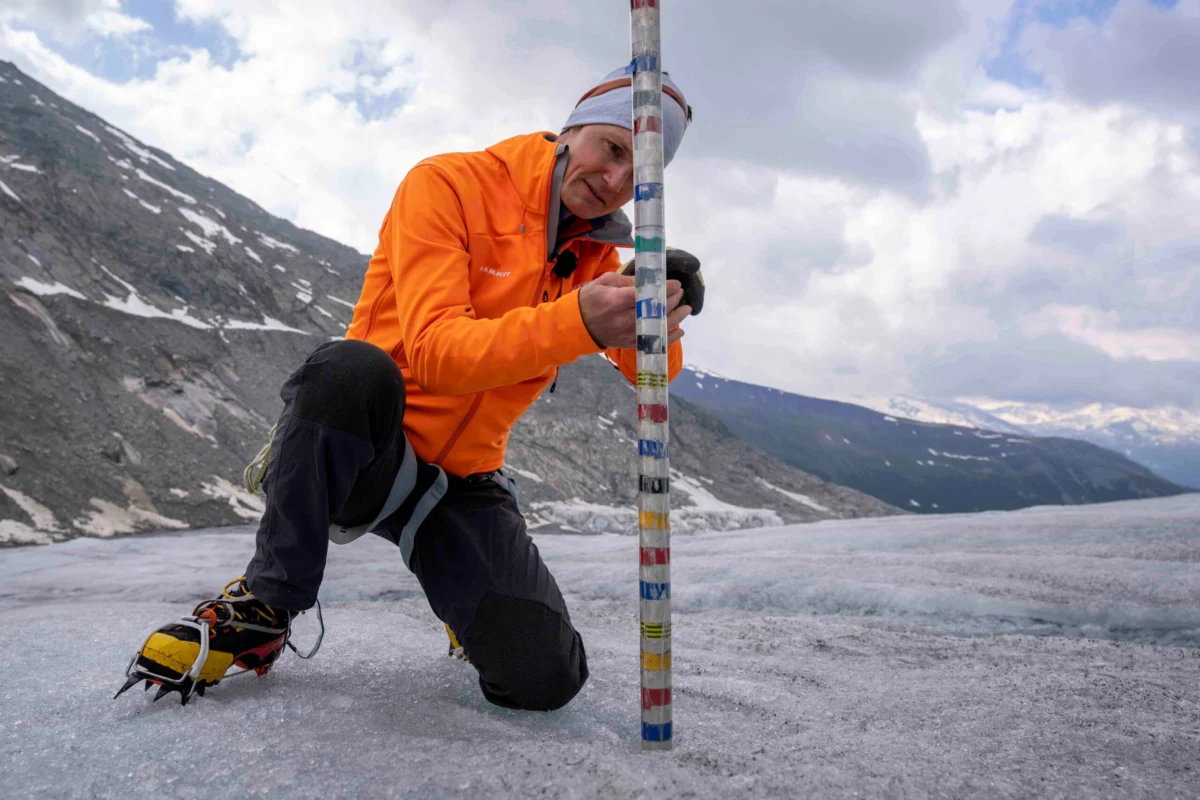
To reach these conclusions, GLAMOS teams conduct extensive fieldwork, often under grueling conditions. Scientists fan out across the peaks to measure snow depth in the spring and ice melt in the autumn. They use a variety of methods, including the installation of ablation stakes—long poles drilled into the ice to measure how much the surface drops—and the use of red dye tracers. By dumping dye into glacial streams and tracking its movement through internal conduits and crevasses, researchers can map the complex "plumbing" systems that develop within melting glaciers.
These internal drainage systems are becoming more prevalent as the ice warms, leading to increased structural instability. The data collected by GLAMOS is integrated into global climate models, providing a clearer picture of how mountain ecosystems are responding to a rapidly changing atmosphere. The Swiss Academy of Sciences has emphasized that the precision of this data is vital for policymakers who must plan for the inevitable socio-economic shifts caused by the loss of these natural reservoirs.
Future Outlook: Stabilization or Extinction?
The consensus among the scientific community is that the future of Swiss glaciers depends entirely on global carbon emissions over the next two decades. Even under optimistic scenarios where the goals of the Paris Agreement are met, a significant portion of the Alps’ ice is already "committed" to melting due to the lag time in the climate system. However, failing to curb emissions will result in the total disappearance of almost all Swiss glaciers by the end of the century.
The stabilization of the climate is the only viable path to preserving what remains. "We just need to stabilize the climate by reducing CO2 emissions, and this will help the glaciers," Huss stated. While the cultural and aesthetic loss of the iconic Swiss peaks losing their white caps is profound, the practical loss of water security and environmental stability is even more pressing. The report serves as a final call to action for European and global leaders to accelerate decarbonization efforts before the "water tower" runs dry.
As the 2024 monitoring season concludes, the visual evidence of the retreat is undeniable. Hiking trails that once crossed ice now cross bare rock and debris. Glacial lakes are forming where solid ice stood just a decade ago. The 5.5% loss of 2024 is not just a statistic; it is a physical transformation of the European landscape, signaling a shift into a new and more volatile climatic era.
