

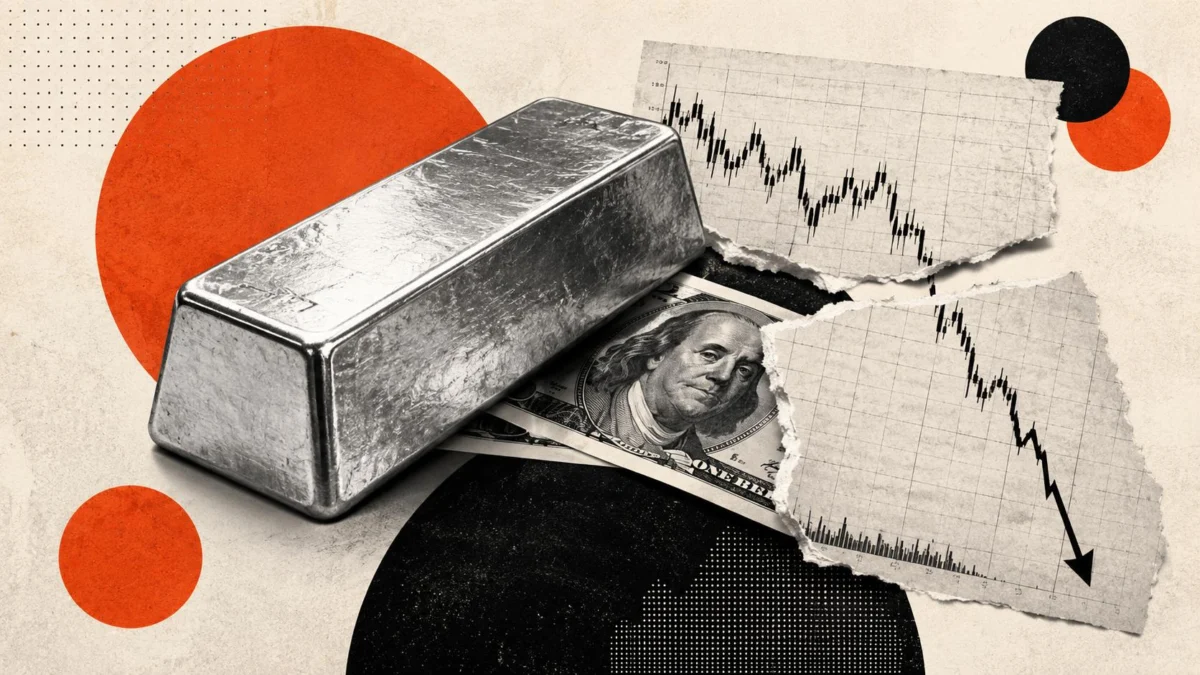
Silver (XAG/USD) experienced a significant downturn in September, trading largely flat on Tuesday around $60.80, its lowest levels in nearly two months. This subdued performance marks a projected 8.5% monthly selloff for the precious metal, underscoring a challenging environment for the broader precious metals complex. The primary drivers behind this pronounced decline are a surging US Dollar and long-term Treasury yields reaching multi-decade highs, fueled by market expectations of at least one more Federal Reserve (Fed) rate hike in the fourth quarter. This confluence of macroeconomic factors has significantly eroded silver’s appeal as a non-yielding asset, pushing it to critical technical junctures.
The Macroeconomic Headwinds: A Resurgent US Dollar and Soaring Yields
The US Dollar Index (DXY), which measures the Greenback’s value against a basket of six major currencies, has been on a relentless upward trajectory throughout September. On Tuesday, it hovered around 101.37 after briefly touching 101.49, its highest level in over a year. This robust dollar rally, which saw the DXY gain nearly 2% in September alone, directly correlates with the decline in precious metals. Historically, silver, like gold, exhibits a strong negative correlation with the US Dollar, meaning a stronger dollar typically makes dollar-denominated commodities more expensive for international buyers, thereby dampening demand and price.
Simultaneously, long-term US Treasury yields have soared to levels not seen in over a decade, further compounding the pressure on silver. The benchmark 10-year Treasury yield, for instance, has surged past 4.5%, reflecting a significant repricing of interest rate expectations and a broader shift in market sentiment. Higher yields make income-generating assets like bonds more attractive relative to non-yielding assets such as silver, increasing the opportunity cost of holding the latter. This dynamic is particularly potent when real yields—nominal yields adjusted for inflation expectations—are on the rise, as they have been.
The Federal Reserve’s Hawkish Stance and Market Repricing
The catalyst for both the dollar’s ascent and the spike in bond yields is the Federal Reserve’s persistent hawkish stance. Throughout 2023, the Fed has maintained its commitment to taming inflation, even as the federal funds rate reached its highest level in 22 years, currently in the range of 5.25% to 5.50%. The September Federal Open Market Committee (FOMC) meeting, while resulting in a pause in rate hikes, saw the release of updated economic projections, commonly known as the "dot plot." This revealed that a majority of FOMC members still anticipate one more rate hike before the end of the year, pushing the median projection for the federal funds rate to 5.6% by year-end. Furthermore, the projections indicated fewer rate cuts in 2024 than previously anticipated, signaling a "higher for longer" interest rate environment.
This hawkish repricing by the market, where investors increasingly expect the Fed to keep rates elevated for an extended period, has been instrumental in strengthening the dollar and pushing up long-term yields. For silver and other precious metals, this scenario presents a formidable headwind. As yield-less assets, their attractiveness diminishes in an environment where investors can secure higher returns from safer, interest-bearing investments.
Unpacking the Yield Surge: Central Bank Credibility and Inflation Expectations
John Velis, an analyst at BNY Markets, offered a nuanced perspective on the yield surge, noting that "instead of long-term inflation driving yields higher, it was ironically perceptions of central bank credibility – markets are expecting the Fed (and other central banks) to raise rates in response to rising inflation." This observation is critical. It suggests that the market is not necessarily fearing an uncontrolled surge in inflation over the long term, but rather demonstrating confidence in the Fed’s ability and willingness to act decisively to contain any renewed price pressures.
This market confidence in central bank credibility has a significant impact on real yields. When the market believes policymakers will respond forcefully to inflation, it can push real yields up, even if longer-term inflation expectations remain relatively contained. Higher real yields directly increase the opportunity cost of holding non-yielding assets like silver, as the real return on alternative investments becomes more appealing. This dynamic explains why silver, despite its historical role as an inflation hedge, struggles when inflation is perceived to be under control by a credible central bank that is actively raising rates.
Broader Precious Metals Landscape: Gold’s Parallel Struggles
Silver’s struggles are not isolated; they mirror a broader downturn across the precious metals complex, including gold. Gold (XAU/USD) has also faced significant pressure from the same macroeconomic forces—a strong dollar and rising real yields—though its decline in September might be slightly less pronounced than silver’s due to its stronger safe-haven appeal in times of geopolitical uncertainty.
The Gold/Silver ratio, which indicates the number of ounces of silver needed to equal the value of one ounce of gold, often provides insights into the relative valuation of the two metals. When this ratio is high, it can suggest that silver is undervalued relative to gold, or vice versa. In the current environment, with both metals facing similar headwinds, their correlation remains strong, and their prices tend to move in tandem, albeit with varying degrees of volatility. While both are considered safe-haven assets, gold typically garners more attention during periods of extreme market stress, potentially offering it slightly more resilience. However, the overarching theme of a hawkish Fed and a strong dollar impacts both significantly.
Silver’s Dual Nature: Industrial Demand vs. Investment Appeal
Silver possesses a unique characteristic among precious metals: its dual role as both an investment asset and an industrial commodity. Unlike gold, which is primarily an investment and jewelry metal, a substantial portion of silver’s annual demand comes from industrial applications. Silver boasts the highest electrical conductivity of all metals, making it indispensable in sectors such as electronics, solar energy, and medical applications. For example, its use in photovoltaic cells for solar panels has seen robust growth, making the clean energy transition a significant demand driver.
During periods of economic expansion, strong industrial demand can provide a floor for silver prices. However, when global economic growth slows, or fears of a recession loom, industrial demand can wane, removing a key support for its price. In the current climate of rising interest rates and potential economic deceleration, the outlook for industrial demand for silver could become less certain, adding another layer of complexity to its price trajectory.
Conversely, investment demand for silver typically rises during periods of high inflation or geopolitical instability, where it is sought as a store of value. Yet, as Velis highlighted, if markets perceive central banks as credible in fighting inflation, the traditional inflation-hedge argument for silver weakens, especially when coupled with the higher opportunity cost presented by elevated bond yields. This delicate balance between industrial and investment demand means silver’s price is susceptible to a wider array of economic indicators than gold.
Technical Outlook: A Bearish Breakout for XAG/USD
From a technical analysis perspective, silver’s recent price action has signaled a significant bearish shift. The impulsive reversal observed on Tuesday saw XAG/USD break decisively below the neckline of a prominent bearish Head & Shoulders (H&S) pattern, situated around the $62.20 area. This break is a classic bearish signal, often preceding further downward movement.
Momentum indicators on the daily chart further reinforce this negative outlook. The Relative Strength Index (RSI 14), a measure of price momentum, has slid below the 40 threshold, indicating increasing selling pressure and a strengthening bearish trend. Similarly, the Moving Average Convergence Divergence (MACD) indicator has steadied within negative territory, confirming the prevailing downward momentum.
Following the H&S neckline breach, bears are currently pushing against immediate support around the September 9 low of $60.87. A sustained break below this level would likely open the path towards the next significant targets. These include the September 8 low at the $59.30 area, followed by the 78.6% Fibonacci retracement level of the July-August rally, positioned around $58.15. The measured target for the completed Head & Shoulders pattern lies even lower, below the year-to-date low of $54.71, suggesting potential for a more substantial decline if the bearish momentum persists unchecked.
On the upside, initial resistance for XAG/USD is now found at the recently breached H&S neckline, just above $62.20. For bearish pressure to ease and for a potential shift in focus towards higher levels, silver would need to convincingly reclaim and hold above this critical resistance. Should it manage to do so, the next target would be the September 5 high, in the $65.00 area, which would require a significant reversal of current market sentiment.
Analyst Perspectives and Market Sentiment
The prevailing sentiment among many market analysts suggests that the path of least resistance for silver, and indeed for most precious metals, remains to the downside in the near term. The "higher for longer" narrative from the Fed, coupled with the dollar’s strength, creates a formidable barrier to any sustained rally. Analysts are closely watching upcoming inflation data, unemployment figures, and further Fed communications for any signs of a pivot in monetary policy, which could provide a much-needed tailwind for silver.
Moreover, the global economic outlook remains a key concern. While a severe recession could theoretically boost silver’s safe-haven appeal, the immediate impact of economic slowdown fears is often a reduction in industrial demand, counteracting any investment-driven gains. The balance between these forces will largely dictate silver’s trajectory.
Implications for Investors and the Global Economy
For investors holding silver, the current environment presents significant challenges. The sustained downtrend necessitates careful risk management and a close watch on macroeconomic indicators. Diversification remains crucial, as the performance of non-yielding assets is heavily influenced by interest rate expectations.
On a broader economic scale, a strong US Dollar has wide-ranging implications. It can make US exports more expensive, potentially hurting American businesses, while making imports cheaper. For emerging markets, a strong dollar often means increased debt burdens, as many countries borrow in dollars, and higher costs for dollar-denominated commodities like oil. This can exacerbate economic fragilities globally, potentially leading to capital outflows from riskier assets. High US Treasury yields also act as a magnet for global capital, drawing investment away from other markets and potentially straining liquidity elsewhere.
Looking Ahead: Potential Catalysts and Future Trajectory
The future trajectory of silver will largely depend on a few key catalysts:
- Federal Reserve Policy Shift: A clear signal from the Fed that its tightening cycle is definitively over, or more importantly, that rate cuts are imminent due to a significant economic downturn, would be the most powerful bullish catalyst for silver.
- Inflation Resurgence: If inflation unexpectedly re-accelerates beyond the Fed’s control, or if central bank credibility is challenged, silver’s role as an inflation hedge could be reasserted.
- Geopolitical Shocks: Major global geopolitical events or financial crises often trigger a flight to safe-haven assets, potentially benefiting silver, though gold typically sees a more pronounced initial surge.
- Economic Recession: A deep global recession, while initially potentially dampening industrial demand, could eventually lead to monetary easing from central banks, which would be bullish for silver.
- Industrial Demand Rebound: A stronger-than-expected rebound in global manufacturing and specific sectors like solar energy could bolster silver’s industrial demand component.
Until such catalysts materialize, the prevailing narrative of a hawkish Fed, a strong dollar, and elevated real yields is likely to keep silver under considerable pressure. Investors will need to navigate this complex landscape with vigilance, weighing the inherent value of silver against the formidable macroeconomic forces currently at play. The coming months will be crucial in determining whether silver can find a floor or if its challenging September performance is merely a precursor to further declines.
