

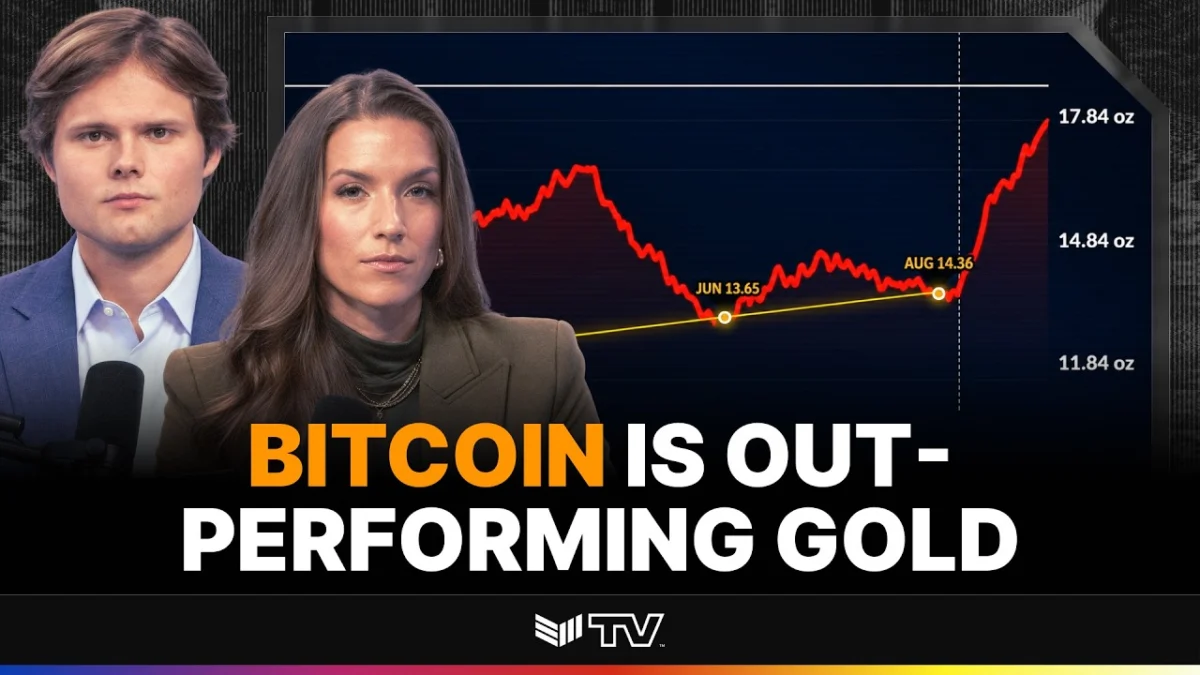
The relationship between Bitcoin and gold, two assets often viewed through contrasting lenses of innovation and tradition, has tightened considerably, with their 90-day correlation reaching a six-year high. This significant development indicates a growing convergence in investor behavior and asset allocation strategies. Furthermore, Bitcoin is now on the cusp of achieving positive year-to-date performance against gold, a milestone that could redefine perceptions of the digital asset’s role as a store of value.
The Shifting Dynamics of Bitcoin and Gold
The recent surge in the Bitcoin-gold correlation suggests that investors are increasingly treating these two assets in a similar fashion, particularly in their response to broader economic and monetary policy shifts. Historically, gold has been the preeminent safe-haven asset, a reliable store of value during times of economic uncertainty, inflation, and geopolitical instability. Bitcoin, on the other hand, emerged as a disruptive digital currency, often perceived as a speculative high-risk, high-reward asset. However, in recent years, a narrative has developed positioning Bitcoin as "digital gold," an alternative store of value in an increasingly digitized world, susceptible to the same inflationary pressures and debasement concerns that affect traditional currencies.
The 90-day correlation metric, which measures the degree to which the price movements of Bitcoin and gold move in tandem over a rolling three-month period, has climbed to levels not seen since 2018. This indicates that when gold prices rise, Bitcoin prices are also more likely to rise, and conversely, when gold prices fall, Bitcoin tends to follow suit. This shared trajectory is a departure from periods where the two assets exhibited little to no correlation or even inverse relationships.
Understanding the Bitcoin-to-Gold Ratio
To contextualize this evolving relationship, analysts often examine the Bitcoin-to-gold ratio, which expresses how many ounces of gold one Bitcoin can purchase. This ratio provides a tangible metric for comparing the relative performance of the two assets, stripping away the influence of dollar debasement. When the ratio increases, it signifies that Bitcoin is outperforming gold; when it decreases, gold is outperforming Bitcoin.
Recent data reveals a compelling trend in this ratio. Since February, the Bitcoin-gold ratio has consistently printed higher lows. This pattern is a hallmark of a bullish trend, suggesting that despite any short-term fluctuations, the underlying momentum favors Bitcoin’s appreciation relative to gold. This sustained upward movement in higher lows indicates growing confidence in Bitcoin’s ability to retain and grow its value in comparison to the traditional precious metal.
A Near-Parity Milestone for 2026
The most striking aspect of this burgeoning correlation is Bitcoin’s proximity to achieving positive year-to-date performance against gold for the year 2026. Currently, Bitcoin is estimated to be just 3% away from surpassing gold’s performance in the current year. This statistic is particularly significant as it pertains to a forward-looking assessment, implying that based on current trends and valuations, Bitcoin is poised to deliver superior returns compared to gold over the full course of 2026.
This achievement, if realized, would represent a powerful validation of the "digital gold" narrative. It would signal that Bitcoin is not only capable of preserving wealth but can also offer substantial capital appreciation in a manner that rivals or even exceeds that of gold, a benchmark for wealth preservation for millennia.
Analysis of Key Chart Developments
Sean, a market analyst, has been closely monitoring the Bitcoin-to-gold chart, identifying several key technical indicators that support the observed correlation and the bullish outlook for Bitcoin relative to gold.
The Bullish Bitcoin Setup: From 12.1 oz to 17.9 oz
The chart analysis highlights a significant expansion in the Bitcoin-to-gold ratio over recent periods. The ratio has climbed from a low of approximately 12.1 ounces of gold per Bitcoin to a new high exceeding 17.9 ounces. This represents a substantial increase in Bitcoin’s purchasing power relative to gold, underscoring its strong performance. This upward trajectory, characterized by higher lows since February, paints a picture of a robust and strengthening bullish setup for Bitcoin against its precious metal counterpart.
The 2026 Yearly Open and Critical Levels
A crucial point of reference for future performance is the 2026 yearly open price for Bitcoin, denominated in ounces of gold. This level is currently estimated at approximately 20.3 ounces of gold. The ability of Bitcoin to maintain its value above this level throughout 2026 would further solidify its position as a superior store of value and a more potent asset for capital appreciation.
Analysts are closely watching key resistance levels that Bitcoin needs to overcome to continue its ascent against gold. The next significant resistance point is identified at approximately 21.5 ounces of gold. Based on current gold prices, this level could translate to a Bitcoin price in the vicinity of $92,000. Breaching this resistance would signal further upward momentum and reinforce the bullish sentiment surrounding Bitcoin’s relative strength.
The Rationale Behind Measuring Bitcoin in Gold
The practice of measuring Bitcoin’s performance against gold, rather than solely against fiat currencies like the U.S. dollar, offers a unique perspective. This approach aims to "strip out dollar debasement." Fiat currencies are susceptible to inflation and monetary policy decisions, which can erode their purchasing power over time. By denominating Bitcoin in gold, analysts can better assess its intrinsic value and its performance as a store of wealth, independent of the fluctuating value of the currency in which it is typically traded.
Gold has historically served as a hedge against inflation and currency devaluation. When investors perceive that a fiat currency is losing value, they often turn to gold to preserve their wealth. By observing Bitcoin’s performance relative to gold, one can infer whether Bitcoin is fulfilling a similar role in the modern financial landscape, acting as a hedge against the erosion of purchasing power in traditional currencies.
Chronology of the Strengthening Correlation
The current high correlation is not an overnight phenomenon but rather a development that has unfolded over several months, with significant acceleration in recent times.
- Early 2023: The Bitcoin-gold correlation was relatively low, with periods of both positive and negative movement. Bitcoin’s price was largely driven by its own idiosyncratic factors, including regulatory news, technological developments, and speculative interest.
- Mid-2023: As inflation concerns persisted and central banks continued their monetary tightening cycles, investors began to explore alternative assets. The narrative of Bitcoin as "digital gold" started gaining more traction, leading to a gradual increase in the correlation.
- Late 2023 – Early 2024: The correlation began to climb more noticeably. This period saw increased institutional interest in both Bitcoin and gold as inflation remained a persistent concern for many economies. The Federal Reserve’s stance on interest rates and potential pivots also influenced both markets.
- February 2024 onwards: The trend of higher lows in the Bitcoin-gold ratio became more pronounced. This indicated a sustained period of Bitcoin outperforming gold on a consistent basis, leading to the current six-year high in the 90-day correlation.
- Present Day: With Bitcoin nearing positive year-to-date performance against gold for 2026, the correlation is at its peak, suggesting a significant convergence in investor sentiment and asset allocation.
Broader Implications for Investors and the Financial Landscape
The increasing correlation between Bitcoin and gold, and Bitcoin’s potential to outperform gold, carries several significant implications for the financial world:
- Validation of Bitcoin as a Store of Value: If Bitcoin continues to demonstrate its ability to act as a reliable store of value and a hedge against inflation, it could attract a wider base of investors, including more conservative institutional players who have historically favored gold. This could lead to increased adoption and market capitalization for Bitcoin.
- Diversification Strategies: Investors who have traditionally relied on gold for portfolio diversification may begin to consider Bitcoin as an alternative or complementary asset. This could lead to a reallocation of capital from traditional markets to digital assets.
- Impact on Monetary Policy: As Bitcoin gains prominence as a store of value, it could influence how central banks view and manage monetary policy. The increasing demand for scarce, non-sovereign assets like Bitcoin might necessitate a reconsideration of traditional approaches to currency management.
- Evolution of Investment Mandates: Financial institutions and asset managers may need to update their investment mandates and risk assessment frameworks to incorporate digital assets like Bitcoin, alongside traditional assets like gold.
- Technological Innovation and Financial Markets: The strong performance of Bitcoin relative to gold underscores the ongoing digital transformation of finance. It highlights how technological innovation can create new asset classes with the potential to rival established ones.
Disclaimer and Future Outlook
It is crucial to reiterate that the views and opinions expressed in the analysis are those of market participants and should not be construed as investment advice. The cryptocurrency market is highly volatile, and investments in Bitcoin carry significant risk. Similarly, gold prices can fluctuate based on various economic and geopolitical factors.
The current trend of increasing Bitcoin-gold correlation and Bitcoin’s strong relative performance suggests a potentially transformative period for digital assets. As the global economic landscape continues to evolve, with ongoing concerns about inflation, currency debasement, and geopolitical instability, investors are increasingly seeking out assets that can preserve and grow their wealth. The data points towards Bitcoin emerging as a significant contender in this pursuit, challenging gold’s long-standing dominance as the ultimate safe-haven and store of value. The coming months and years will be critical in observing whether this trend solidifies and how it reshapes the broader investment landscape.
The analysis presented by Sean, focusing on the Bitcoin-to-gold ratio, higher lows since February, and the approach towards positive year-to-date performance against gold for 2026, provides a compelling snapshot of this evolving market dynamic. The identified resistance levels, such as the 21.5-ounce mark, will be key indicators to watch as the market navigates this period of heightened correlation and potential paradigm shift.
