

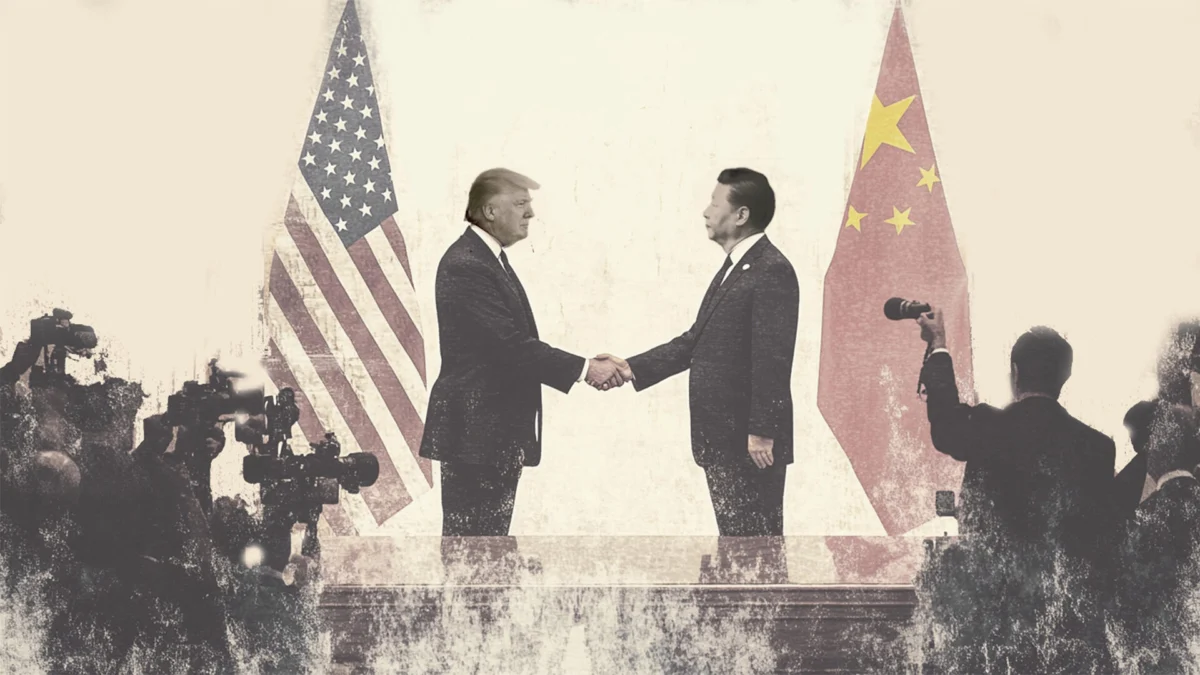
US Treasury Secretary Scott Bessent announced on Wednesday that the United States and China have agreed to extend a crucial bilateral trade truce, known informally as the "Busan Agreement," from its original expiry date in November through January 10. This significant development, reported by Bloomberg, emerged following an unscheduled, high-level meeting in Washington between Secretary Bessent and China’s Vice Premier He Lifeng, underscoring a renewed commitment to de-escalation in the fraught economic relationship between the world’s two largest economies. The extension provides a critical window for further negotiations, with both sides signaling openness to either a more comprehensive economic package or continued temporary agreements.
The announcement came just hours before Chinese President Xi Jinping, accompanied by his wife Peng Liyuan, touched down at Joint Base Andrews outside Washington, marking a pivotal moment in US-China relations. President Xi expressed optimism about his visit, stating he was "confident" the trip would produce "fruitful results," a sentiment that resonated deeply with the preceding trade truce extension. This diplomatic overture follows a period of intense geopolitical competition and economic friction, highlighting the imperative for dialogue despite deep-seated differences.
Unpacking the "Busan Agreement" and Its Origins
Secretary Bessent’s reference to the "Busan Agreement" as an "economic détente" between the two nations signifies a deliberate strategy to manage and mitigate trade tensions that have periodically threatened global economic stability. While not a formal treaty, the "Busan Agreement" framework, as described, appears to represent a series of understandings or a tacit agreement to refrain from escalating trade protectionism, particularly regarding new tariffs or retaliatory measures. Its genesis can be traced back to previous high-level engagements where both countries sought to stabilize economic ties and prevent a complete breakdown of trade relations, often in response to market volatility and concerns from global business communities.
The initial understanding, set to expire on November 10, likely established a baseline for current trade practices, effectively freezing the imposition of new tariffs or the intensification of existing trade barriers. This temporary peace provided a degree of predictability for businesses operating in both markets, allowing for supply chain adjustments and strategic planning without the immediate threat of escalating costs or market access restrictions. The decision to extend this détente through January 10 suggests that while progress has been made, substantive agreement on a more permanent framework requires additional time and negotiation. Bessent explicitly stated the possibility of a "larger economic package" being agreed upon by January, but also acknowledged the practicality of merely "rolling the current deal" and extending it further if comprehensive solutions prove elusive. This flexibility underscores the delicate balancing act involved in managing the complex US-China economic relationship.
A Chronology of US-China Trade Tensions
The backdrop to this extended truce is a turbulent history of trade disputes that formally erupted in early 2018 under the Trump administration. President Donald Trump initiated a series of aggressive trade barriers against China, citing what he characterized as unfair commercial practices, intellectual property theft, and forced technology transfers from Chinese entities. The initial salvo involved tariffs on steel and aluminum imports, soon followed by broader tariffs on a wide range of Chinese goods, impacting sectors from electronics to machinery.
China swiftly retaliated, imposing its own tariffs on various US products, including agricultural goods like soybeans, automobiles, and chemicals. This tit-for-tat escalation quickly evolved into a full-blown trade war, causing significant disruption to global supply chains, increasing costs for consumers and businesses in both countries, and injecting considerable uncertainty into the global economy. For instance, US farmers, particularly soybean producers, faced severe losses as China, a major buyer, shifted its procurement to other countries. Similarly, American consumers saw prices rise on imported goods, while Chinese manufacturers struggled with reduced access to the US market.
The tensions reached a temporary peak with the signing of the US-China Phase One trade deal in January 2020. This agreement, while not fully resolving all disputes, mandated structural reforms in China’s economic and trade regime, including commitments on intellectual property protection, technology transfer, and financial services. Crucially, China also pledged to significantly increase its purchases of US goods and services over two years, totaling an additional $200 billion above 2017 levels. While the Phase One deal aimed to restore stability and trust, its implementation was significantly complicated by the onset of the global Coronavirus pandemic, which diverted focus and disrupted global trade flows.
Despite the change in administration, President Joe Biden largely maintained the tariffs imposed by his predecessor, indicating a bipartisan consensus on the need to address China’s economic practices. While the Biden administration shifted its focus to strategic competition and alliances, the tariffs remained a significant point of contention, contributing to ongoing economic friction. The current truce and diplomatic push can thus be seen as an effort to navigate this legacy of tariffs and find new pathways for engagement.
Economic Implications and Market Reactions
The extension of the trade truce offers a temporary reprieve for global markets and businesses. The immediate market reaction, as observed at the time of writing, saw the AUD/USD pair down 0.06% on the day at 0.7034. The Australian dollar (AUD) is often considered a proxy for global trade sentiment and commodity prices, particularly those tied to China’s economic health, given Australia’s significant trade ties with the Asian powerhouse. A slight dip in AUD/USD following the announcement, despite the positive news of a truce extension, could reflect a nuanced market assessment. Investors might be factoring in the temporary nature of the extension, the ongoing uncertainty regarding a larger deal, or perhaps profit-taking after earlier rallies on hopes for improved relations.
Economists largely view any de-escalation of trade tensions as beneficial, as it reduces uncertainty and potential inflationary pressures. A full-blown trade war typically leads to higher import costs, which are often passed on to consumers, contributing to inflation. Furthermore, disruptions to global supply chains can hinder manufacturing and increase operational costs for businesses worldwide. The truce extension, even if temporary, allows companies to plan with greater confidence, potentially encouraging investment and stabilizing commodity markets.
Analysis from institutions like the International Monetary Fund (IMF) has consistently highlighted the negative impact of trade protectionism on global GDP growth. Estimates have suggested that a full-scale trade war could shave off significant percentage points from global economic output. Therefore, even a limited truce is seen as a positive step towards fostering a more predictable and open international trading environment. Industries heavily reliant on US-China trade, such as technology, agriculture, and manufacturing, stand to benefit most directly from the continuation of economic détente. For instance, semiconductor companies, often caught in the crossfire of technology competition, might see a temporary easing of restrictions or a clearer path for cross-border collaboration.
Statements and Official Outlooks
Secretary Bessent’s remarks about the potential for a "larger economic package" by January suggest that the current discussions are not merely about maintaining the status quo but about forging a more comprehensive framework for economic engagement. Such a package could potentially address long-standing issues beyond tariffs, including market access for foreign companies, industrial subsidies, data governance, and climate change cooperation. These are complex areas where both nations have significant interests and divergent approaches, requiring extensive negotiation and political will.
Chinese President Xi Jinping’s confident statement about "fruitful results" from his trip underscores China’s strategic interest in stabilizing relations with the US. For China, maintaining a stable trade relationship is crucial for its economic growth, which is currently navigating domestic challenges. Access to US markets and technology remains vital, even as China strives for greater self-reliance. From a US perspective, while competition remains a defining feature, cooperation on global issues like climate change, pandemic preparedness, and macroeconomic stability necessitates open lines of communication and a functioning economic relationship.
Broader Geopolitical Context
The trade truce and high-level meetings are not isolated events but are deeply embedded within the broader geopolitical rivalry between the US and China. Beyond economics, the two powers are locked in competition across various domains, including technology leadership, military influence in the Indo-Pacific, and ideological differences over governance and human rights.
The economic détente, therefore, serves as a vital channel for managing this multifaceted competition, preventing it from spiraling into unmanageable conflict. Analysts suggest that while neither side is likely to abandon its strategic objectives, a period of reduced trade friction can create space for dialogue on other critical issues. For example, progress on trade could pave the way for discussions on Taiwan, cybersecurity, or regional security architectures, where tensions are particularly acute. The presence of President Xi in Washington for these discussions elevates the importance of these engagements, signaling a commitment at the highest levels to de-escalate tensions and explore areas of mutual interest.
Expert Analysis and Future Scenarios
Experts in international relations and economics are cautiously optimistic about the truce extension. Dr. Eleanor Vance, a senior fellow at the Global Trade Institute, noted, "This extension is a welcome pause, preventing an immediate return to hostile trade practices. It buys both sides time to develop more sustainable solutions, moving beyond piecemeal agreements towards a more robust framework." She emphasized that the true test will be whether this goodwill translates into concrete progress on structural issues by January.
The path forward remains uncertain, with several possible scenarios emerging by the January 10 deadline. One optimistic scenario envisions the successful negotiation of a "larger economic package," which could involve a reciprocal reduction of tariffs, new market access agreements, and commitments on intellectual property protection, leading to a more stable and predictable trade environment. Such an outcome would likely be cheered by businesses and investors globally.
Alternatively, the two countries might opt to "just roll the current deal," extending the existing truce further. This scenario would reflect ongoing challenges in reaching comprehensive agreements, perhaps due to domestic political constraints or fundamental differences that require more time to bridge. While less ambitious, a continued truce would still be preferable to a renewed trade war, maintaining a fragile stability.
A less desirable but plausible scenario involves a failure to reach any new agreement, leading to the expiration of the truce without a follow-up. This could potentially reignite trade tensions, with the possibility of new tariffs or retaliatory measures. This risk is particularly amplified by the upcoming US presidential election cycle. The prospect of Donald Trump’s return to the White House in 2025 looms large over these discussions. During his 2024 election campaign, Trump pledged to impose 60% tariffs on China once back in office, which, if enacted, would dramatically escalate the trade conflict beyond previous levels. This long-term uncertainty adds pressure on current negotiators to establish a more durable framework before such a potential shift in US policy.
Ultimately, the extension of the "Busan Agreement" represents a critical step in the ongoing effort to manage the complex and often contentious relationship between the United States and China. It underscores a mutual recognition of the need for dialogue and de-escalation, even as fundamental differences persist. The coming months will be crucial in determining whether this temporary truce paves the way for a more enduring economic stability or merely delays a potential resurgence of trade hostilities. The world watches closely as these two economic giants navigate a path between cooperation and competition.
