

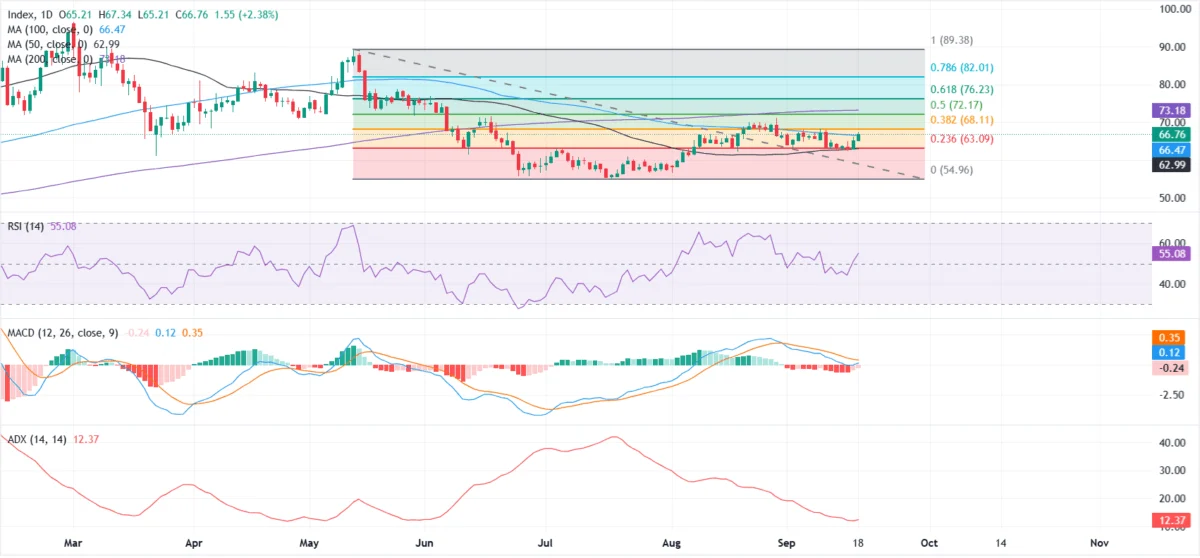
Silver (XAG/USD) experienced a notable upward trajectory on Friday, extending its weekly gains as the US Dollar retreated from its intraday advances. The precious metal reached approximately $66.76, marking its highest trading level since September 10 and positioning it for a weekly gain exceeding 3%. This move reflects a broader market dynamic where traders engaged in profit-taking after the Greenback’s robust performance earlier in the week, yet the metal’s long-term outlook remains tempered by elevated US Treasury yields and the Federal Reserve’s persistently hawkish monetary policy stance.
Immediate Market Drivers and the Dollar’s Reversal
The immediate impetus for silver’s ascent on Friday was the US Dollar’s intraday reversal. Following a period of significant strength, the Greenback experienced a bout of profit-taking, which is a common market phenomenon where investors sell assets after a substantial price increase to lock in gains. This action led to a softening of the Dollar against a basket of major currencies, thereby making dollar-denominated assets like silver more attractive to international buyers. The inverse relationship between the US Dollar and commodities priced in it is a fundamental principle in financial markets, as a weaker dollar effectively lowers the cost of these commodities for holders of other currencies.
Throughout the week, the US Dollar had demonstrated considerable resilience, largely bolstered by anticipation and then confirmation of the Federal Reserve’s latest monetary policy decisions. However, Friday saw a shift in this sentiment, with the Dollar showing weakness against several major counterparts. While the Dollar maintained strength against the Japanese Yen, appreciating by 0.47% against it, it registered declines against the Euro (-0.05%), British Pound (-0.23%), and Swiss Franc (-0.31%). This broad-based softening provided the necessary tailwind for silver to capitalize and push higher.
The Federal Reserve’s Shadow: A Persistent Headwind
Despite silver’s recent gains, the underlying macroeconomic environment, particularly the Federal Reserve’s monetary policy, presents a significant headwind. On Wednesday, the Federal Open Market Committee (FOMC) concluded its latest meeting by raising the federal funds rate by 25 basis points, bringing the benchmark rate to a new range. This decision, widely anticipated, underscores the Fed’s unwavering commitment to combating persistent inflation and steering it back towards its long-term target of 2%.
Crucially, the Fed’s post-meeting statement and subsequent commentary from Chair Jerome Powell signaled that "additional tightening may be needed." This hawkish forward guidance suggests that the central bank is prepared to implement further rate hikes if inflationary pressures do not subside as expected. The implication of such a stance is twofold:
- Elevated US Treasury Yields: Higher interest rates generally translate to higher yields on government bonds. As US Treasury yields remain elevated, they increase the opportunity cost of holding non-yielding assets like silver. Investors may opt for the guaranteed returns of bonds over the speculative gains of precious metals, especially in a high-interest-rate environment.
- Stronger Dollar Potential: A continued hawkish stance by the Fed, particularly if other major central banks adopt a more dovish approach, could reinforce the US Dollar’s strength over the medium term. This would naturally exert downward pressure on silver prices.
Chronology of Key Economic Events Influencing Silver
The recent movements in the silver market are best understood within a timeline of significant economic events and policy decisions:
- Early Week (Monday-Tuesday): The US Dollar began the week with a strong footing, primarily driven by market expectations of a hawkish Federal Reserve meeting outcome. Economic data, including stronger-than-expected employment figures or resilient inflation metrics, often contribute to this sentiment, fueling demand for the dollar as a safe-haven and higher-yielding currency.
- Wednesday: Federal Reserve Meeting: The FOMC announced a 25 basis point rate hike. More importantly, the accompanying statement and press conference by Chair Powell reiterated the Fed’s commitment to fighting inflation, suggesting the possibility of further rate increases. This initially supported the dollar and kept a lid on precious metal prices.
- Thursday: Post-Fed Market Reaction: Markets continued to digest the Fed’s hawkish tone. US Treasury yields remained elevated, reflecting the higher interest rate environment. Silver’s movement was largely contained, consolidating around prior levels.
- Friday: Profit-Taking and Dollar Retreat: A significant wave of profit-taking hit the US Dollar. Traders, having seen the Greenback’s robust performance following the Fed’s decision, opted to realize gains. This broad dollar weakness provided a crucial window for silver to rally, breaking past resistance levels and achieving its multi-week high.
This sequence highlights the complex interplay between central bank policy, currency markets, and commodity prices. While short-term profit-taking can offer temporary relief, the overarching monetary policy narrative often dictates the longer-term trend.
Silver’s Dual Nature: Industrial Demand and Safe-Haven Appeal
Silver, unlike gold, possesses a dual identity as both a precious metal and an industrial commodity. This dual nature means its price is influenced by a wider array of factors:
-
Industrial Demand: Silver boasts the highest electrical and thermal conductivity among all metals, making it indispensable in numerous industrial applications. Key sectors include:
- Electronics: Used in switches, contacts, conductors, and circuit boards across a vast range of consumer electronics.
- Solar Energy: A critical component in photovoltaic cells, with demand surging due to the global push for renewable energy.
- Automotive: Increasingly utilized in electric vehicles (EVs) due to its conductive properties and lightweight nature, contributing to efficiency.
- Medical and Photography: Applications in medical imaging, sterile instruments, and specialized photography.
The strength of global manufacturing, particularly in major economies like the US and China, directly impacts industrial silver demand. India’s demand also plays a crucial role, albeit more skewed towards jewelry and investment. A robust global economy with expanding industrial output tends to boost silver prices, while a slowdown or recession can dampen demand.
-
Safe-Haven Status and Investment Demand: Historically, silver has served as a store of value and a hedge against inflation and economic uncertainty, albeit to a lesser extent than gold. During periods of geopolitical instability or fears of a deep recession, investors often flock to precious metals. As a yieldless asset, silver tends to perform better in environments of lower interest rates, as the opportunity cost of holding it decreases. Investment vehicles such as Exchange Traded Funds (ETFs) and direct purchases of physical silver (coins and bars) allow investors to gain exposure to its price movements. The Gold/Silver ratio, which indicates how many ounces of silver are needed to buy one ounce of gold, is a key metric for investors. A high ratio often suggests silver is undervalued relative to gold, potentially signaling a buying opportunity for silver.
Technical Analysis: A Mixed Picture
From a technical perspective, XAG/USD exhibits a constructive near-term tone but faces significant resistance further out.
- Moving Averages: On the daily chart, the price of silver is comfortably trading above its 50-day Simple Moving Average (SMA) and 100-day SMA, indicating underlying support from the medium-term trend. The 50-day SMA, typically around $63, and the 100-day SMA at $66, serve as crucial dynamic support levels. However, the 200-day SMA, a key long-term trend indicator, remains a distant barrier at $73.18, suggesting that while the immediate outlook is positive, a strong bullish breakout requires overcoming substantial long-term resistance.
- Oscillators and Momentum: The Relative Strength Index (RSI) is currently at 55. This reading leans mildly bullish without indicating overbought conditions, suggesting there is still room for upward movement before the asset becomes technically overextended. Conversely, the Moving Average Convergence Divergence (MACD) indicator is slightly negative, hinting that while upside momentum is improving, it is not yet decisive. The Average Directional Index (ADX) reading of 12 further supports this, indicating a weak trend environment, meaning the current upward move lacks strong conviction and could be susceptible to reversals.
- Key Support Levels: Immediate support for silver is aligned with the 100-day SMA at $66. A break below this could see the price testing the 50-day SMA near $63, which converges with the 23.6% Fibonacci retracement level at $63.09. This cluster forms a critical demand area. A sustained break below this zone could open the path towards the structural low around $55, signaling a more significant bearish shift.
- Key Resistance Levels: On the upside, initial resistance is encountered at the 38.2% Fibonacci retracement at $68.11. A successful breach of this level would target the 50.0% retracement at $72.17, followed closely by the formidable 200-day SMA at $73.18. Overcoming this cluster of resistance levels would be a strong bullish signal, potentially opening the way towards higher Fibonacci levels at $76.23 and $82.01, where significant supply zones are anticipated.
Broader Implications and Outlook
The recent rally in silver, while encouraging for bullish investors, must be contextualized within the broader economic landscape. The Federal Reserve’s commitment to higher-for-longer interest rates suggests a challenging environment for non-yielding assets. However, should global economic uncertainties escalate, or if there’s a perceived dovish pivot from central banks, silver’s safe-haven appeal could resurface strongly.
For industrial users, price volatility in silver can impact production costs and profitability. Industries like solar and electronics, which are heavily reliant on silver, constantly monitor price movements to manage supply chains and hedging strategies. A sustained period of high silver prices could prompt some industries to seek alternatives or optimize usage, while lower prices could stimulate demand.
Looking ahead, the trajectory of silver will largely depend on two pivotal factors: the evolution of the US Dollar’s strength, heavily influenced by Fed policy, and the underlying health of global industrial demand. Any signs of an economic slowdown or recession could trigger renewed safe-haven buying, while a robust global manufacturing sector would bolster industrial consumption. Investors will be closely watching upcoming inflation data, employment figures, and central bank communications for clues on the future direction of monetary policy and its subsequent impact on the precious metals market. The current environment suggests a cautious optimism for silver, balancing short-term gains with significant long-term structural challenges.
