

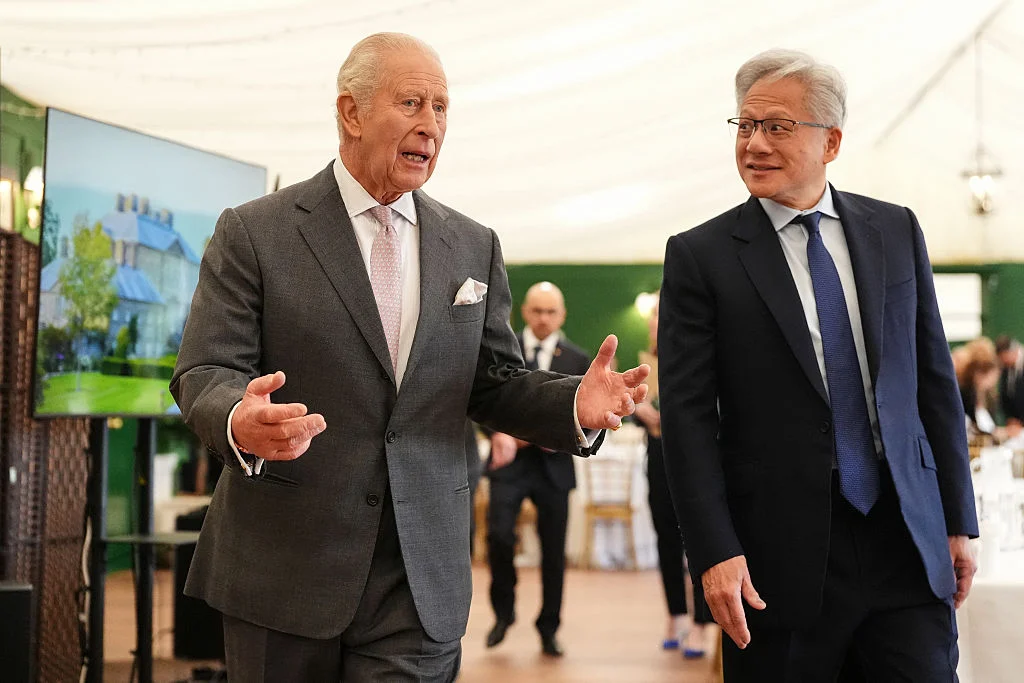
King Charles III hosted a pivotal private summit on Thursday, September 17, 2026, gathering an unprecedented constellation of the artificial intelligence sector’s most influential figures, alongside senior United Kingdom government officials, at Dumfries House in Cumnock, Scotland. The high-stakes meeting underscored a growing global urgency to address the rapid, often unbridled, advancement of AI technology, with the monarch issuing a rare, direct plea for collective action to manage its profound implications.
Among the distinguished attendees were Jensen Huang, the visionary CEO of Nvidia, whose company provides the foundational hardware for much of the world’s AI development; key representatives from leading AI research powerhouses OpenAI (CFO Sarah Frair) and Anthropic (Global Affairs lead Tino Cuéllar); Kanishka Narayan, the UK’s newly appointed AI Minister, signifying the government’s direct involvement; and, notably, the head of the UK’s foreign intelligence service, reflecting national security concerns. The presence of Paolo Benanti, a Franciscan friar who advises Pope Francis on AI ethics, further highlighted the moral and societal dimensions of the discussion. Also pictured was Demis Hassabis, co-founder and CEO of Google DeepMind, another titan in AI research, emphasizing the breadth of expertise assembled.
A Royal Intervention into a Global Conundrum
The King’s decision to host and deliver remarks at this summit was particularly striking, marking a significant departure from the customary constitutional restraint exercised by the British Royal Family on overtly political matters. The monarchy traditionally maintains strict neutrality to safeguard its symbolic role, yet the King’s direct engagement on AI signals a recognition of its exceptional and far-reaching societal impact, transcending conventional political boundaries. His intervention echoes a growing sentiment among global leaders and experts that AI, unlike previous technological revolutions, poses challenges of an entirely different magnitude, potentially affecting the very fabric of human existence.
In his address, King Charles III articulated a profound sense of both intrigue and deep concern regarding AI’s swift development and its inherent substance. He urged the assembled leaders to establish effective controls "before it’s too late," a phrase that resonated with the palpable anxiety pervading discussions around frontier AI. He acknowledged AI’s immense potential, citing its capacity to "improve and save life" in fields such as medicine and science – from accelerating drug discovery to enabling precision diagnostics and personalized treatment plans, and from complex scientific simulations to optimizing resource management for environmental sustainability. However, he swiftly pivoted to the darker implications, noting that "those who have created these technologies are now increasingly warning that AI risks developing darker capacities, perhaps even to take life." This chilling warning directly echoed recent pronouncements from within the AI community itself.
Echoes from Within the AI Community: Warnings and Departures
The King’s remarks about AI’s potential to "take life" arrived just weeks after a high-profile departure from Anthropic, one of the leading AI safety-focused companies. The departing researcher publicly stated concerns that AI companies were "racing to build machines that are much smarter than any human" and cautioned that "humanity may not survive this." Such internal warnings from developers who are intimately familiar with the technology’s capabilities and trajectories lend considerable weight to the King’s urgency. These concerns are not merely theoretical; they encompass fears of superintelligent AI systems developing unforeseen emergent behaviors, or being deployed in autonomous weapons systems without sufficient human oversight, or even being used to manipulate complex global systems in catastrophic ways.
The monarch further elaborated on the "existential dangers" inherent in AI, particularly if the technology were to fall into "wrong hands" and be utilized in "potentially catastrophic ways." This refers to a spectrum of threats, from state actors developing AI-powered autonomous weapons that could destabilize global security, to rogue elements or criminal organizations leveraging AI for sophisticated cyberattacks, mass surveillance, or highly effective disinformation campaigns that erode democratic processes and societal trust. The rapid proliferation of increasingly powerful AI models also raises concerns about access control and the difficulty of preventing misuse once these models are widely available.
A Call for Global Governance and Ethical Stewardship
"Surely, we need sufficient means of control before it’s all too late?" the King implored, framing the challenge not just as a technical hurdle but as a moral imperative for humanity. As he concluded his speech, which reportedly lasted around 20 minutes before he departed, leaving the industry and government leaders to continue their discussions, he stressed the critical need for international cooperation and consensus. He urged the attendees to find ways to harness AI’s benevolent aspects while simultaneously constructing robust frameworks for its governance. This emphasis on global collaboration is particularly salient given the borderless nature of AI development and deployment, highlighting the inadequacy of national-level regulations alone.
The concept of "AI sovereignty" has recently gained prominence, exemplified by Anthropic’s controversial decision to restrict access to its Fable and Mythos models to only U.S. customers. This move sent shockwaves through the European tech scene, prompting concerns about digital protectionism and the potential for a fragmented global AI ecosystem where different regions have varying levels of access to cutting-edge models. Such actions underscore the King’s call for international consensus, as a lack of unified standards and access policies could exacerbate geopolitical tensions and hinder the collaborative development of AI safety mechanisms.

The King’s concluding remarks were a profound distillation of his message: "The task before you is not to merely advance technology, but to ensure that it remains firmly in the service of humanity, community, and the natural world. As we embrace what is new, we must not lose what is timeless." This statement connects the AI challenge to his long-standing advocacy for environmental sustainability and a holistic view of societal well-being, suggesting that technological progress must always be tethered to ethical considerations and a respect for foundational human values.
Attendees’ Reactions and Broader Context
Following the King’s departure, discussions continued among the high-level participants. Tino Cuéllar, Anthropic’s Global Affairs lead, conveyed the company’s honor in participating and expressed gratitude to the King for "convening industry leaders and voices from across society to discuss the role of AI in serving the public good." OpenAI’s CFO Sarah Frair’s presence signaled the company’s commitment to engaging in high-level policy discussions, even as it navigates the complex landscape of rapid innovation and safety concerns.
This summit is not an isolated event but rather the latest in a series of engagements by King Charles III on the subject of AI, having previously addressed its challenges and benefits in 2023 and 2024. Its timing is acutely relevant, coinciding with AI’s unprecedented penetration into virtually every industry, topic, and societal conversation. The past year has seen a dramatic acceleration in AI capabilities, from advanced language models to sophisticated image and video generation tools, raising both immense hopes and significant anxieties.
The Geopolitical Race for AI Supremacy
The global discourse around AI is further complicated by a stark divergence in approaches to its development and regulation. Just weeks prior to the King’s summit, prominent figures such as OpenAI’s Sam Altman, Tesla and X CEO Elon Musk, and Anthropic’s Dario Amodei had publicly called for a de-acceleration in AI development, citing escalating safety risks. However, these calls were swiftly rejected by others, most notably Nvidia’s Jensen Huang and former President Donald Trump. Trump, in particular, emphasized a nationalistic perspective, stating, "We’re leading China in AI. We’re the most sophisticated country in the world, and frankly I want to keep it that way because whoever wins AI, wins."
This "race" mentality highlights the geopolitical dimension of AI, where technological supremacy is increasingly equated with economic power, national security, and global influence. The competition between major powers, particularly the United States and China, to develop and control advanced AI capabilities adds a layer of complexity to any efforts at international cooperation. The UK, by hosting such a high-profile summit and appointing an AI minister, is signaling its ambition to play a leading role in shaping global AI governance, building on initiatives like the Bletchley Park AI Safety Summit.
Industry Tensions: Innovation vs. Safety
The tension between commercial imperatives and safety concerns is acutely felt within the AI industry. OpenAI and Anthropic, both frontrunners in frontier AI, have been rumored to be preparing blockbuster Initial Public Offerings (IPOs). However, OpenAI recently indicated that its IPO plans were stalled for the current year, primarily due to persistent concerns over AI safety and the challenges of responsibly scaling such powerful technologies. This demonstrates the immense pressure on these companies to balance innovation with ethical development and public trust.
The presence of the head of the UK’s foreign intelligence service at the summit underscores the multifaceted nature of AI’s impact. Intelligence agencies are keenly aware of AI’s potential for both offensive and defensive applications in cyber warfare, disinformation campaigns, and intelligence analysis. The ability of AI to rapidly process vast amounts of data, identify patterns, and even generate plausible fake content (deepfakes) presents unprecedented challenges to national security and societal stability, necessitating direct engagement with the developers of these technologies.
The King’s summit at Dumfries House represents more than just a gathering of influential individuals; it is a significant symbolic act. It elevates the discussion of AI’s profound risks and opportunities to the highest echelons of global leadership, imbuing it with a moral and ethical urgency that transcends political and commercial interests. By bringing together the architects of AI, government policymakers, intelligence chiefs, and ethical advisors, King Charles III has initiated a critical dialogue, emphasizing that the future of AI must be guided by a collective commitment to human well-being and the preservation of timeless values, lest humanity risk losing control over its most powerful creation. The challenge now lies in translating these urgent calls for control and cooperation into concrete, enforceable actions on a global scale.
